
In the Blue Sea, where the water ran deep and cold, filled with silver fish and green seaweed and coral reefs, thousands of waves were born each day. But one small wave, called Wavey, struggled to reach the shore like all the others—until an old whale taught him a life-changing lesson.
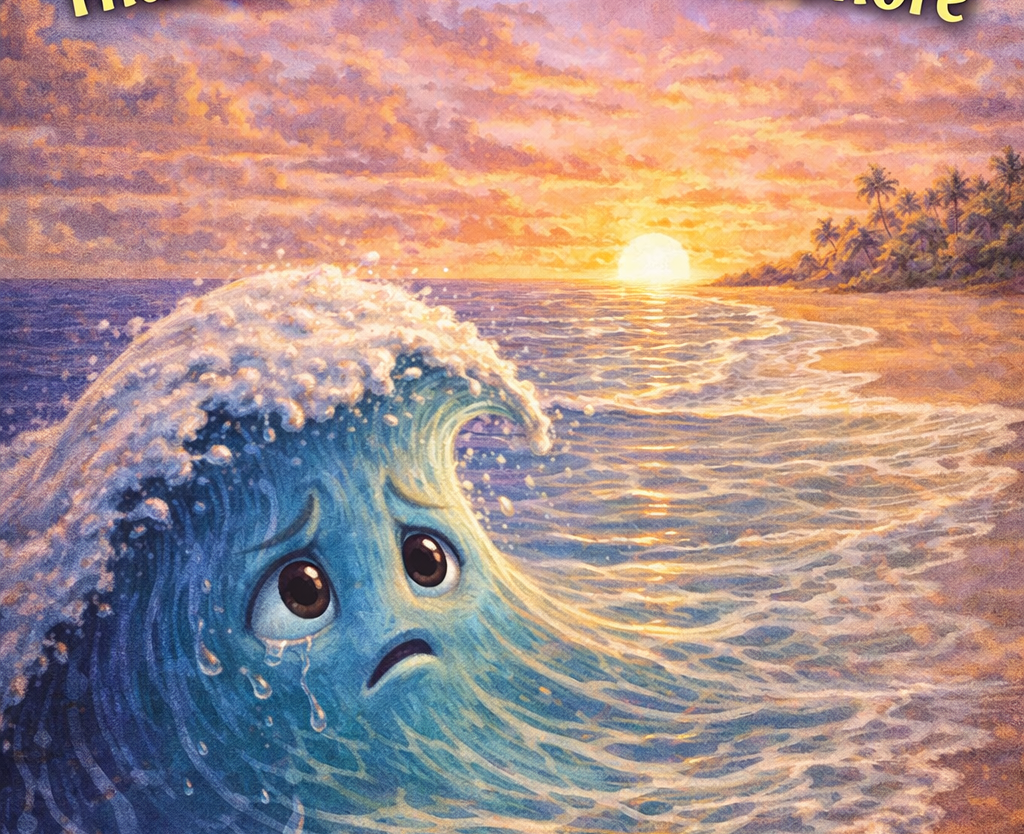
The Little Wave That Never Reached the Shore: A Timeless Tale of Finding Your Own Path
*audio coming soon*
In the Blue Sea, where the water was deep and cold and full of silver fish and green seaweed and red corals, thousands of waves were born each day.
Once set in motion, the waves would travel — always forward, always toward the shore, until they reached the beach and broke into white foam with a sound of whoooosh that people loved so much they traveled from far away just to hear it.
All waves reached the shore.
All of them, except for Wavey.
Wavey was a small wave. The smallest wave in the entire sea. The other waves were tall and powerful and blue, with white foam crests foaming in the wind. Wavey was… modest. Undulating. A bit hesitant.
But Wavey wanted to reach the shore just like all the others.
And every day he tried.
The first attempt.
Wavey set off from far away, with all his small strength. He rose, he swelled as much as he could, he caught the wind at his back and moved — forward, forward, forward.
But along the way, a large wave named Lightning overtook him at speed, struck him from the side and scattered him.
Wavey found himself back in the middle of the sea, flat and dispersed like a puddle.
— Sorry! Lightning shouted from afar, without turning around.
— I’ll try again tomorrow, said Wavey.
The second attempt.
This time Wavey set off earlier, when the large waves were still sleeping. He moved carefully, avoiding currents, keeping his course straight toward the beach.
He had reached halfway when a strong wind blew from the shore. Wavey pushed. The wind pushed back. Wavey pushed harder. The wind blew even stronger.
And Wavey turned back to where he came from.
— I’ll try again tomorrow, he said, a little more tired.
The third attempt.
Wavey moved slowly but steadily. He avoided the cold current. He evaded the rocks. He had come closer than ever before — he could already see the beach sand, yellow and gleaming.
And then, the King of the Waves came from behind, lifted Wavey high up and carried him forward — and passed him and broke on the shore himself with a great roar, while Wavey landed tens of meters from the beach, exhausted and diminished.
— Tomorrow… Wavey began.
And he stopped.
He didn’t say tomorrow anymore. He was tired of tomorrow.
He let himself drift on the still water and remained.
Other waves passed by him. All of them arrived.
— Why can’t I arrive too? said Wavey to himself.
An old, deep voice answered from beneath him:
— Because you’re looking at them instead of looking ahead.
There, in the depths of the water, moved slowly an old whale named Splashy — enormous, with her back covered in crustaceans and scars, with eyes small and calm like two river stones.
— I’ve seen millions of waves coming and going, she said. And I’ve seen many who didn’t arrive.
— Many? I thought I was the only one who couldn’t reach it.
— You’re not alone. There are waves that compare themselves to the large ones and become discouraged, waves that start but stop halfway.
Wavey felt a little less alone.
— And how did those who arrived manage it?
— They stopped looking at the large waves, said Splashy. And they started looking at the beach.
— When you look at Lightning or the King of the Waves, what do you feel?
— Small, said Wavey honestly. I feel small and slow and unimportant.
— And when you look at the beach?
Wavey looked toward the shore. He saw the yellow sand, children playing at the water’s edge, shells gleaming in the sun, a dog running through the foam.
— I feel that I want to reach there, he said.
— That’s exactly what you need to feel. Not “I’m smaller than Lightning.” But “I want to get there.” Each wave has its own rhythm. Lightning is fast — good for him. You’re small — and that can be good for you.
— How?
— A large wave breaks with noise and ends quickly. A small wave can travel further on the sand. It can reach places where large waves cannot — higher up on the beach, closer to the children building castles, closer to the shells at the water’s edge. Your size is not a disadvantage. It’s just different.
— Different, repeated Wavey.
— Different, confirmed Splashy. Now go. And don’t look left or right anymore.
Wavey set off.
This time he didn’t look at Lightning as he overtook him. He didn’t look at the King of the Waves. He didn’t look at any wave.
He looked at the beach.
At the yellow sand. At the children there. At the small shiny shells.
He moved. Slowly, steadily, at his own pace.
The wind blew and he didn’t stop. A cold current appeared and he avoided it patiently. A large wave overtook him at speed and he didn’t look.
Forward. Forward. Forward.
And then, without fanfare, without great roar, without spectacular foam —
Wavey reached the shore.
A small, gentle wave that climbed the warm, wet sand higher than the large waves that had broken noisily ten minutes before.
Right beside a pink shell that a little girl had been searching for all morning.
The girl saw the shell, picked it up and cried out:
— I found it! Mom, I found it!
Wavey retreated into the sea, gently and content.
— You made it, said Splashy.
— I made it.
— And how was it?
Wavey thought of the girl with the pink shell.
— It was worth it. Even though it took longer.
— It’s always worth it, said Splashy. Even when it takes longer.
And Wavey set off again toward the open sea. To prepare for tomorrow.
The End.
And you, if you don’t succeed at something on the first try, don’t look at others. Look at where you want to go. Everyone has their own rhythm — and yours is perfect. 🌊
You might also like:
The Girl Who Wanted to Touch the Moon
- he Boy Who Spoke With the Wind
- Courageous Lion Who Didn’t Want to Roar
- Candy Bear and the Missing Cake
\

Comments are closed.