
Fractional CO2 laser can genuinely transform skin texture, but recovery requires discipline and realistic expectations. Learn what to expect, how many sessions you need, and which questions to ask your doctor.
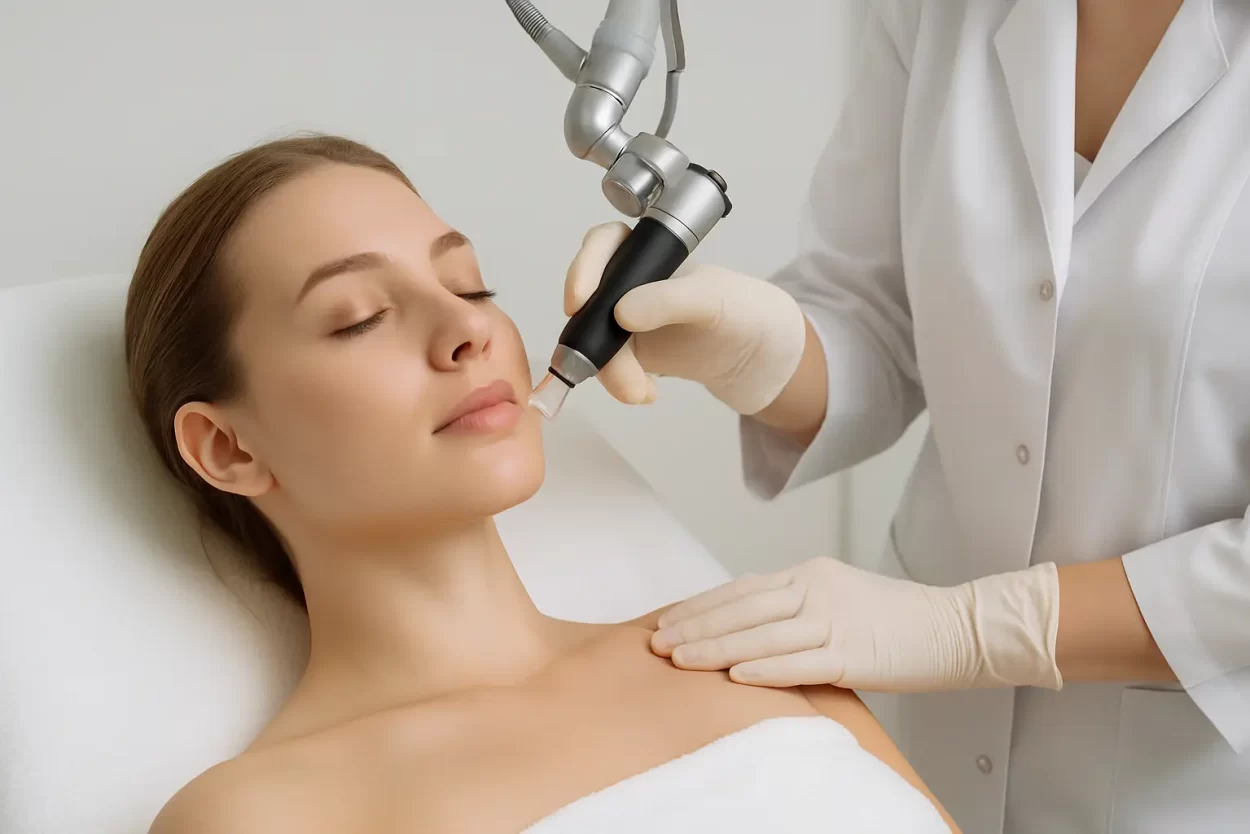
Fractional CO2 Laser: Complete Guide to Results, Recovery & What to Expect
You look in the mirror and notice that your foundation no longer sits the same way—dilated pores, post-acne scars, fine lines, or spots that won’t budge even with SPF. In this area, fractional CO2 laser is one of those procedures that can genuinely change skin texture, but it comes with a price: recovery, discipline, and realistic expectations.
The article below tells you clearly and concisely what this type of laser does, who it makes sense for, how a session unfolds, how long healing takes, and what questions to ask before you pay.
What is fractional CO2 laser, explained simply
Fractional CO2 laser is an ablative laser that deliberately “polishes” skin by delivering energy in micro-points (tiny columns) and leaving untouched skin zones between them. The fractional concept helps faster healing than full resurfacing, because skin has healthy “islands” from which it can repair itself.
CO2 refers to the laser type (carbon dioxide), and its main effect is twofold: at the surface it exfoliates the top layer, while deeper down it stimulates collagen. This is where results come from for texture, pores, scars, and fine lines.
What problems is it worth considering for
It’s not a “weekend glow laser.” It’s a procedure for things that genuinely bother you and don’t respond enough to cosmetics or gentler treatments.
Most often it’s used for post-acne scars (especially atrophic ones, the “pitted” kind), visible pores, and uneven skin texture. It can help with fine lines too, especially around the mouth or eyes, but settings need to be adapted very carefully there.
It’s also used for spots (certain forms of hyperpigmentation) or sun damage, but here it “depends” a lot on skin type and season. If you tend toward post-inflammatory pigmentation, your doctor will weigh the risk versus benefit and may recommend another strategy or stricter prep.
When it’s not the best choice
Fractional CO2 laser isn’t for everyone and not at any time.
If you have a recent tan (including self-tanner), the risk of spots after the procedure increases. If you have active infections, recurring herpes without prophylaxis, or severe inflammatory acne, the problem needs controlling first.
With melasma (hormonal spots) it can be a double-edged sword: sometimes it helps, sometimes it makes it worse, especially if strict sun protection doesn’t follow. If you’re pregnant or breastfeeding, most clinics postpone aggressive procedures.
If you expect scars to disappear completely after a single session, better set a different goal from the start: visible improvement, not perfection.
How a session unfolds (and why settings matter)
Before the procedure, there’s a consultation and, ideally, a discussion about your skin history: recent treatments, isotretinoin in the past, tendency toward keloid scarring, herpes, irritating products.
On session day, numbing cream is usually applied and you wait for it to work. The procedure itself can be uncomfortable—sensation of heat and stinging. Duration depends on the area: a full face can take anywhere from a few minutes to longer, depending on protocol.
Settings (energy, density, number of passes) are the “steering wheel” of results and recovery. More aggressive doesn’t automatically mean better. For deep scars you can work focused, and for general texture you go with milder, repeatable parameters.
Recovery after fractional CO2 laser: what to expect day by day
Most people underestimate recovery. Not just redness, but a combination of burning sensation, skin darkening, then exfoliation.
In the first 24-48 hours, skin is red and “hot,” like after serious sunburn. Swelling may appear, especially around the eyes.
Days 3-5 are usually when skin starts to dry and form micro-crusts or a brown “film.” That’s when the temptation to pick is strong. Don’t do it. Pulling off crusts increases the risk of scarring and spots.
Around days 5-7, many people already look presentable, but redness can persist longer, sometimes several weeks, depending on intensity and skin sensitivity. Makeup is reintroduced only when skin is completely closed with no raw areas.
Practically, if you have an event, plan the procedure with buffer time. For a medium protocol, think at least 7-10 days until you feel socially comfortable, and longer if intensive work was done.
Proper post-procedure care (the difference between “okay” and “wow”)
After fractional CO2 laser, your routine gets drastically simplified: gentle cleansing, restorative hydration, strict sun protection. In the first days, your doctor may recommend an occlusive ointment or repair creams, plus cleansing with very gentle products.
What matters most is keeping the skin barrier calm and hydrated. That means no exfoliants, no retinoids, no acidic vitamin C, and no fragrances until skin is fully healed.
SPF is non-negotiable. Ideally SPF 50, reapplied when you go outside, plus a hat and avoiding direct exposure. If you skip sun protection, you risk “buying” spots right after investing in an expensive procedure.
And one more practical detail: change your pillowcase often in the first few days and avoid the gym, sauna, and swimming until you get your doctor’s okay. Sweat and bacteria can complicate healing.
How many sessions are needed and when you see results
It depends on the problem and how aggressively the work is done. For texture and pores, sometimes 1-2 well-executed sessions can bring clear change. For post-acne scars, often you need a series of 2-4+ sessions, spaced weeks apart.
Results appear in layers. There’s an initial “wow” when the rough skin comes off, but true collagen improvement builds over time, over 2-3 months after the session. That’s why proper evaluation is done at distance, not at one week.
Risks and side effects: what’s normal and what’s not
Redness, dryness, tightness sensation, and exfoliation are normal. So is increased sensitivity to products.
What deserves serious discussion are risks that, while not common, exist: post-inflammatory hyperpigmentation (especially with darker skin types or after sun exposure), infections (bacterial or herpes reactivation), scarring if healing is disrupted, and rarely, hypopigmentation (lighter patches).
That sounds like a lot, but that’s exactly why choosing the right doctor, appropriate settings, and following post-procedure care matters. A good procedure isn’t just about the machine, but also the hand using it.
How to choose a clinic and what questions to ask at consultation
If you want results and safety, don’t stop at “what machine do you have?” Ask who actually does the procedure, what experience they have with your type of problem, and what plan they propose.
It’s worth clarifying how many days of downtime to realistically plan, what products you’re allowed before and after, how they manage herpes risk (if you’ve had it), and what the protocol looks like if hyperpigmentation appears.
Ask for an honest estimate too: how many sessions are likely for your scars and what level of improvement is realistic. A good professional will tell you directly when you need to combine treatments (for example, subcision for certain scars, microneedling, or other procedures in stages), not just repeat the same session.
Fractional CO2 laser versus other options: when to choose what
If you need a procedure with less recovery, there are non-ablative lasers or fractionated radiofrequency that can improve texture with fewer “off” days, but usually with more subtle results per session.
For post-acne scars, sometimes combinations are more effective than “just one laser”: subcision can free tethered scars, fillers can temporarily lift depressions, and a fractionated laser can refine surface texture.
If your main concern is spots, sometimes a plan with depigmenting ingredients, controlled peels, and strict sun protection may suit you better than CO2, especially if you have melasma.
How much it costs and why it varies so much
Price depends on city, clinic, doctor’s experience, treated area, and protocol intensity. A full face costs differently than targeted scar treatment. Sometimes post-procedure products and follow-ups are included in the cost, sometimes not.
If you see very cheap offers, ask exactly what’s included and what parameters are used. “Cheaper” can mean settings too mild (weak results) or, worse, a protocol unsuitable for your skin.
For more practical beauty guides explained simply, you’ll find similar articles at https://muniom.com/.
In the end, approach fractional CO2 laser as a short project, not an improvisation: you schedule it when you can spend a few days in the healing rhythm, you prep a simple routine, and you ask the uncomfortable questions at your consultation. Skin changes beautifully when you give it time and when you don’t rush to “fix” everything in one session.


Comments are closed.