
Choosing between an induction and gas hob comes down to speed, control, safety, and daily convenience. We break down real advantages for Romanian homes—from apartments to houses—so you can decide what actually matters for your kitchen.
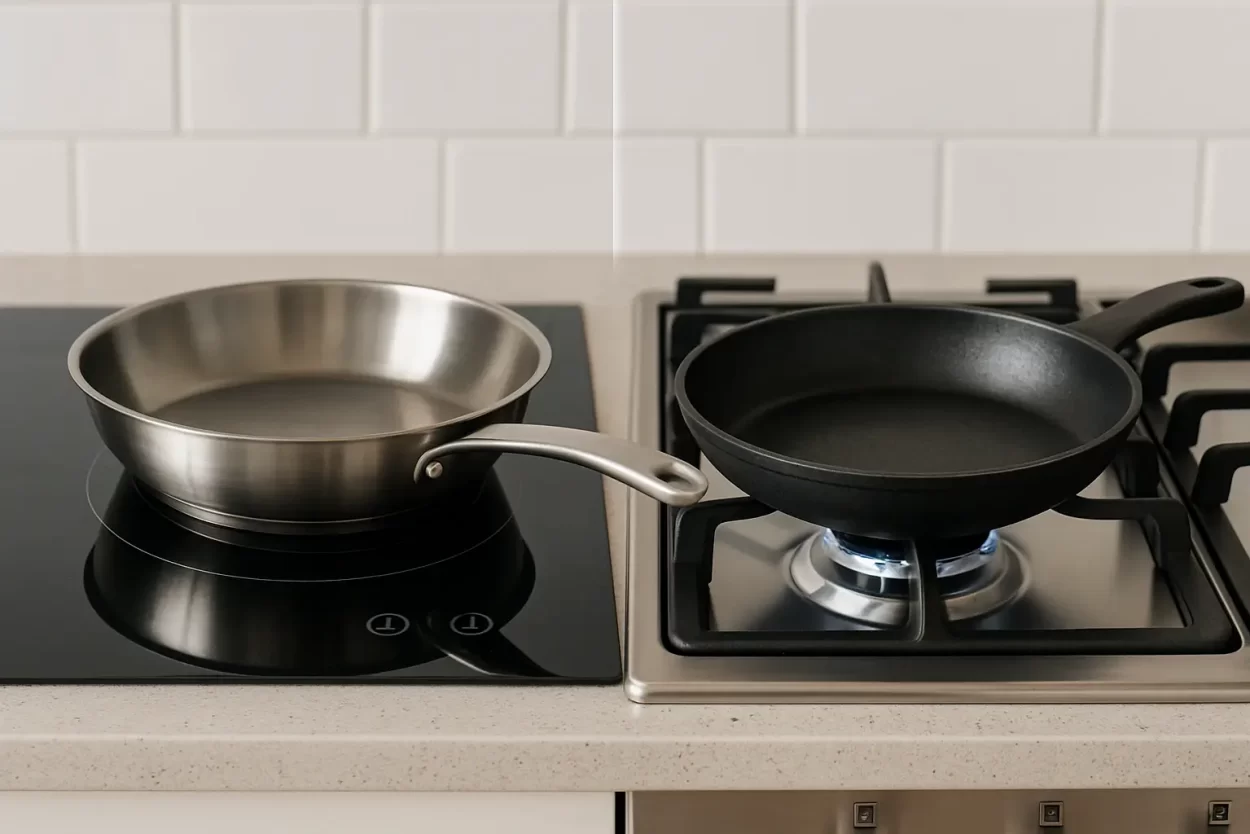
Induction or Gas Hob: Real Advantages Compared for Your Kitchen
Have you ever watched water boil too slowly when you’re in a hurry, only to have it come to a rolling boil the moment you turn your back—splattering everywhere? The choice between an induction and gas hob becomes crystal clear in moments like these: speed, control, cleaning, safety, and honestly, saved nerves.
Rather than telling you “it depends” and leaving you confused, I’ll show you clearly what induction versus gas hobs offer, with real scenarios from kitchens: apartment living, houses with gas canisters, small children underfoot, daily cooking or just weekends.
How they work, briefly (and why it matters)
With gas, the flame heats the bottom of your pan directly. It’s simple, intuitive, and forgiving: almost any cookware works, and if the power goes out, you can still cook.
With induction, the hob creates an electromagnetic field that heats the pan itself (not the “eye”). This brings two major effects: rapid heating and a cooler surface around it. But there’s a catch: you need compatible (ferromagnetic) cookware.
Induction vs gas hob: cooking speed and control
Induction wins on speed in most home cooking scenarios. For boiling water, pasta, soups, blanching vegetables, or anything “I need this fast,” the difference is immediate. Plus, it responds incredibly quickly when you reduce power—you go from a rolling boil to a gentle simmer without waiting for the flame to die down or the grate to cool.
Gas has a classic advantage: visual control. You see the flame and adjust instinctively. If you’ve cooked on gas for years, the transition to induction might feel odd for 2-7 days, until the power levels become second nature.
For delicate cooking (creams, sauces, chocolate over a water bath, milk rice), induction helps through stable heat levels and often lets you set timers by zone. On the other hand, if you love high-flame wok cooking, with fire licking up the sides, gas remains better suited—induction can heat excellently, but it won’t perfectly mimic the flame “embracing” the pan.
Costs: what you pay now and what you pay monthly
This is where the most wrong assumptions happen. There’s no universal winner, because it depends on three things: your local energy prices, how much you cook, and what power and efficiency your hob has.
Induction is generally more energy-efficient in terms of heat transfer (less waste to the air). That can mean better costs long-term, especially if you cook frequently and use rapid boiling often.
Gas can be cheaper in some households, especially where there’s a gas line with favorable rates and moderate cooking habits. But you have “invisible” costs that add up: maintenance, laborious cleaning, and sometimes the need for a more powerful hood because of combustion.
One practical detail: if you already have a gas installation and a working gas hob, switching to induction might also require checking your electrical setup (circuit breakers, wiring, available capacity). The initial investment can be higher than you’d imagine, even if the hob itself is reasonably priced.
Safety: children, pets, hurried habits
In the induction versus gas hob discussion, safety is why many people make the switch.
Induction significantly reduces the risk of open flame and accidental ignition of a towel, napkin, or oil left too close. The surface heats mainly from the pan, so the area around it stays cooler than with traditional hobs. Still, “cooler” doesn’t mean “cold”—if you’ve been boiling for a long time, the glass heats up too, so you still need caution.
Gas comes with two typical risks: flame and possible leaks. Modern hobs usually have flame-out safety, but that doesn’t replace proper ventilation and maintenance. If you tend to cook with wide sleeves, towels on your shoulders, or curious children wanting to “press buttons too,” induction helps because many models have child locks and automatic shutoff.
Cleaning and maintenance: the difference you feel daily
If you want a kitchen that looks good with minimal effort, induction has a very concrete advantage: a flat glass surface you wipe down quickly. Spilled milk or sauce that boils over doesn’t burn as aggressively as on a flame-heated hob, because the surrounding area isn’t glowing hot from constant heat.
With gas, cleaning means grates, caps, burners, and areas where grease collects. It’s not impossible, but it takes longer and makes you procrastinate. And when you procrastinate, it becomes “weekend project.”
However, induction needs care against scratches. If you drag a heavy pan across the glass or use abrasive pads, it shows. This doesn’t necessarily affect functionality, but it affects appearance—and for many modern kitchens, appearance matters.
Ventilation and comfort: kitchen air makes a difference
Gas burns oxygen and produces heat and combustion fumes. In a small kitchen, especially in summer, it feels more “hot” and stuffy. A good hood becomes more important, and regular airing really makes a difference.
Induction heats the surrounding air less, so your kitchen generally stays more comfortable. You’ll still have steam and food smells, but without the combustion component. For apartments with an open-concept kitchen into the living room, this is an advantage you’ll appreciate right away.
Compatible cookware and adjustment: induction’s hidden cost
The main “but” with induction is cookware compatibility. If you have a collection of thin aluminum pots, ceramic, or non-ferrous stainless steel, they might not work. Simple trick: a magnet that sticks well to the bottom of a pan is usually a good sign.
This doesn’t mean you have to replace everything at once. Many people transition smartly: keep what’s compatible, gradually replace pieces that don’t work, and choose pans with thick bottoms that distribute heat more evenly.
With gas, the advantage is freedom: you use almost anything, including baking trays, old ibrik, heirloom cabbage-roll pots, or traditional woks.
When induction makes sense (quick, real scenarios)
Induction is an excellent choice if you cook often and want time saved, if you have small children or pets and want to reduce risks, if you have an open-concept kitchen and want thermal comfort and quick cleaning. It’s also good for those who want a modern, “clean” look and appreciate features like timers, pause, and keep-warm functions.
On the other hand, if you have frequent power cuts, if you cook a lot with wok or high flames, or if your kitchen has limited electrical capacity (old wiring, low available power), induction can become frustrating without extra investment.
When gas makes sense (and why it’s still popular)
Gas remains very practical if you already have good infrastructure and value independence from electricity. It’s suitable for “rustic” cooking, for direct flame, for recipes where you like to see and feel the fire. And yes, if you have many old pots you don’t want to replace, gas keeps everything simple.
But consider daily comfort: kitchen heat, laborious cleaning, and the need for good ventilation.
Simplified decision: ask yourself 5 questions
If you want to choose without spending hours, answer honestly: do you cook daily or occasionally? Do you have small children or curious pets? Is your kitchen small or open-concept? Can your electrical installation handle higher consumption? Are you willing to gradually replace your cookware?
If most answers point to “I want fast, clean, safe, comfortable,” induction makes sense. If they point to “I want flame, flexibility, works without power, no extra investment,” gas remains the natural choice.
For more practical guides about home choices, you’ll find articles on muniom.com that shorten your journey from “I don’t know what to buy” to “I know exactly what suits me.” And when you choose your hob, think about a surprisingly important detail: not the weekend recipe, but Tuesday’s dinner in a hurry—that’s where you really see which advantage matters for you.

Comments are closed.