
Transform your narrow, small, or dark hallway into an elegant and functional space with practical design solutions. Discover expert tips on colors, mirrors, furniture, and lighting that work for any hallway type.
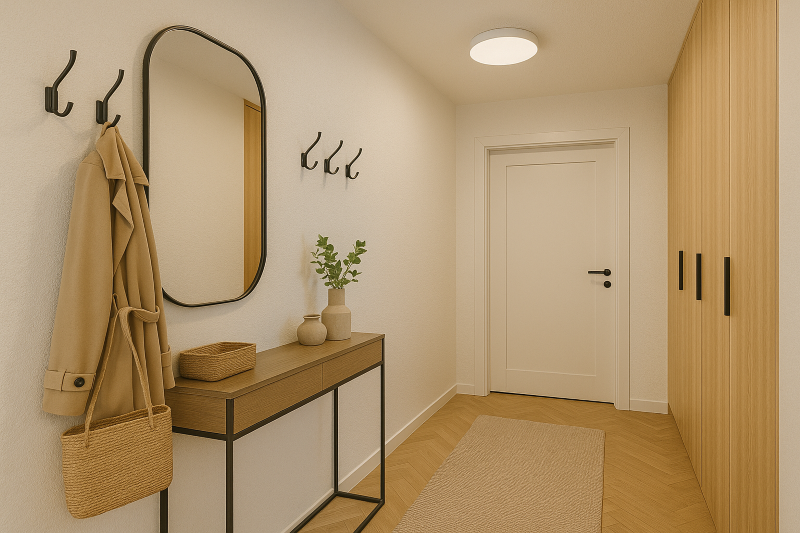
Designing a Narrow and Small Hallway – Practical Ideas for Any Space
Your hallway is the first thing you see when you come home — and the first thing your guests see too. But in many Romanian homes, the hallway is small, narrow, poorly lit, and packed with suitcases, jackets, and shoes. It seems impossible to design it beautifully, right?
It’s not. With a few simple, well-thought-out ideas, any hallway — whether narrow, long, small, or windowless — can become a functional and pleasant space. In this guide, you’ll find concrete solutions for every type of problem, without major renovations and without a huge budget.
What type of hallway do you have? Identify the problem to find the right solution
Not all hallways are alike. Before you buy anything, it’s useful to understand what type of space you’re working with:
- Narrow and long hallway – the classic apartment corridor: 1-1.5 m wide, 3-6 m long
- Small and square hallway – compact space, usually under 4 sqm
- Hallway without natural light – no windows, light comes only from other rooms or artificial sources
- Hallway with many doors – rooms opening from all sides, fragmented space
Each type has its own solutions. Read the section that fits you — or all of them, if you want complete inspiration.
Designing a narrow and long hallway: how to transform a corridor into an elegant space
The long and narrow hallway is perhaps the most common in Romanian apartments. The main problem: it creates a tunnel sensation. The solution: work with its shape, not against it.
Colors and materials that “widen” visually
Choose light colors on the walls: white, cream, light gray, beige. If you want an accent wall, choose the one at the end of the hallway — this draws the eye inward and creates the illusion of space, not narrowness.
Avoid horizontal stripes and large patterned wallpapers. Instead, vertical stripes (whether through wallpaper or wood paneling) visually raise the space.
Mirrors — the most effective trick
A tall, narrow mirror on a side wall works wonders. Not only does it reflect light, but it also “breaks” the tunnel effect. If you have space, a mirror covering the entire length of one wall completely transforms the perception of space.
Practical idea: Install full-height mirrored wardrobe doors. You get both storage and a widening effect, all in one solution.
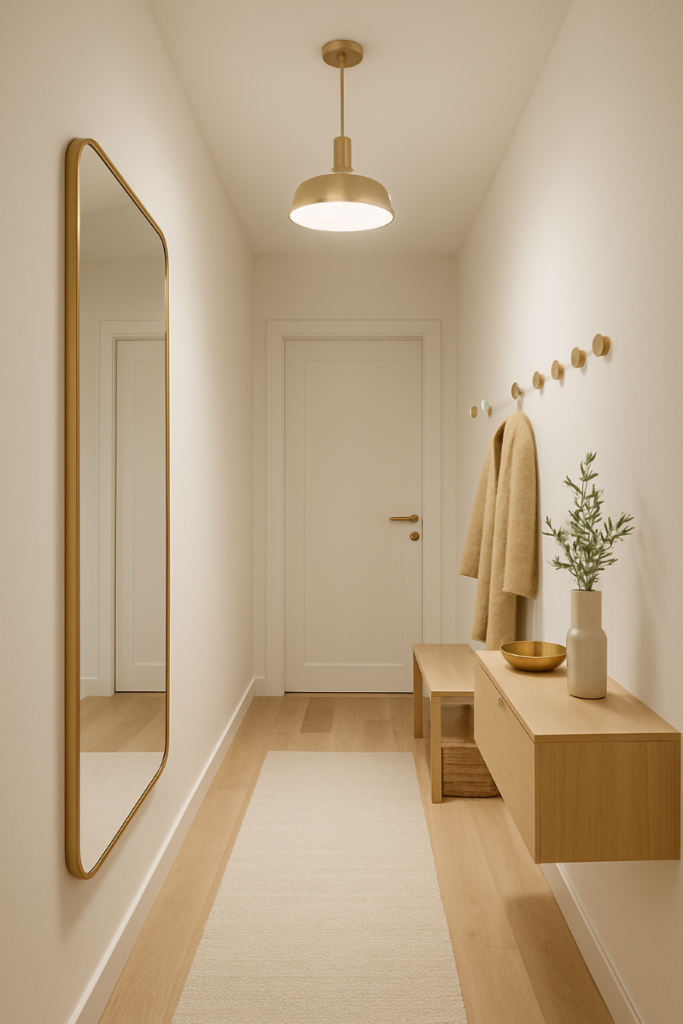
Furniture for the long and narrow hallway
Basic rule: maximum depth of 30-35 cm for any piece of furniture. Anything deeper blocks circulation.
Recommended solutions:
- Vertical narrow shoe rack (20-30 cm depth) — holds many pairs, takes up little space
- Slim console with one or two drawers — for keys, glasses, small items
- Wall-mounted coat rack with shelves — instead of a standalone rack that takes up floor space
- Narrow bench with storage space — practical for putting on shoes, and hides shoes inside
Designing a small and square hallway: maximize every centimeter
\ \
The square hallway has the advantage of not being a “tunnel”, but the disadvantage is that space is easily lost if not well organized.
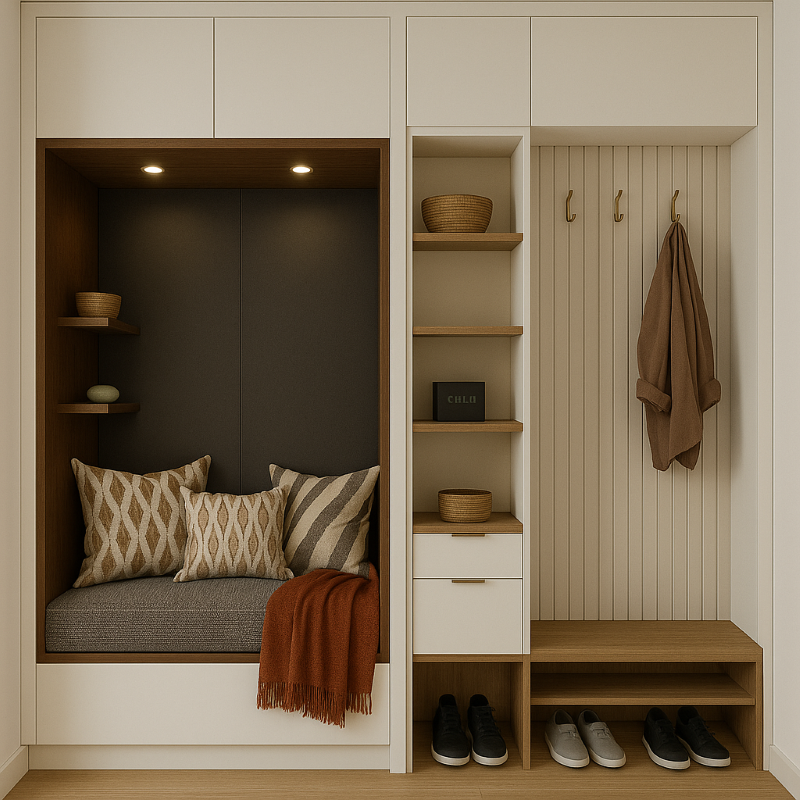
Go vertical
When floor space is limited, height is your friend. Install shelves and cabinets up to the ceiling. The upper area (difficult to access daily) is perfect for seasonal storage: suitcases, winter pillows, Christmas decorations.
Wardrobe or no wardrobe?
If the square hallway is at least 1.5 x 1.5 m, a wardrobe with sliding doors on one entire wall is the best long-term investment. It hides everything — jackets, umbrellas, shoes, shopping cart — and keeps the rest of the hallway free and airy.
If it’s smaller than that, skip the wardrobe and choose wall solutions: hooks, shelves, hanging shoe racks.
Flooring matters more than you think
Use the same type of flooring as the adjacent room. Visual continuity makes the hallway seem like an extension of a larger space, not a separate box. Avoid small, cramped rugs — if you put a rug, choose one that covers almost the entire surface or don’t use one at all.
Hallway without natural light: how to keep it from looking like a cave
Lack of a window is a real challenge, but it has clear solutions.
Layered lighting — the key to a bright artificial hallway
Don’t rely on a single ceiling light. Build lighting on multiple levels:
- General lighting — recessed LED spotlights in the ceiling, spread light evenly
- Accent lighting — LED strips under shelves or behind mirrors, create depth
- Decorative lighting — a wall sconce with nice design, adds personality
Color temperature matters: Choose warm light bulbs (2700-3000K) for a welcoming atmosphere, not cold office lighting.
Practical lighting tricks
- Motion sensors — you enter with full hands, the light turns on by itself
- Mirrors with integrated LED lighting — reflect and illuminate simultaneously
- Extra-light colors on walls — pure white reflects artificial light much better than cream or gray
Organization ideas that work for any type of hallway
Regardless of the shape or size of your hallway, these organizational principles work universally.
Create zones even in tight spaces
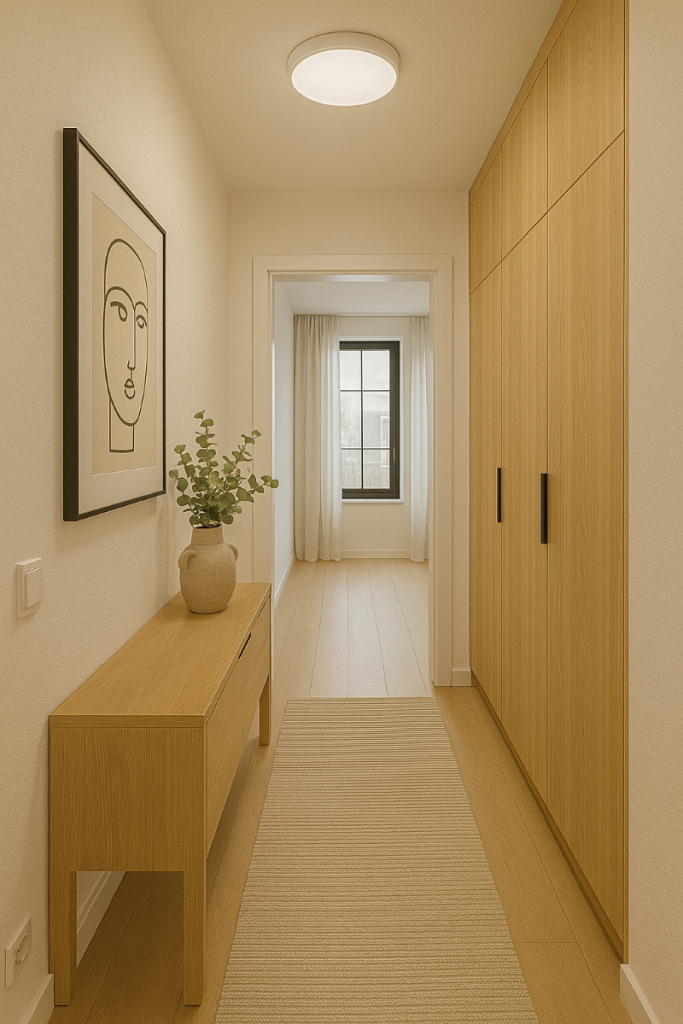
A runner rug (long and narrow) defines the entry area and protects the floor. A coat rack or set of hooks marks the “hanging” zone. A bench or small stool creates the “shoe-putting-on” zone. Three small zones, but the hallway looks planned and organized.
Hide the ugly, show the beautiful
The basic principle of an elegant hallway: everything ugly is hidden, everything beautiful is displayed. Dirty shoes — in a shoe rack or basket. Bags and backpacks — in a closet or on hidden hooks. On shelves or console — a decorative object, a plant, a lamp.
Plants in the hallway — yes or no?
Yes, if you have at least good artificial light. Choose plants that tolerate low light: pothos, zamioculcas, sansevieria. A tall plant (1 m+) in a simple pot adds life and visual height without taking up much floor space.
Common mistakes in small hallway design (and how to avoid them)
❌ Too much furniture — the hallway isn’t a living room. Every piece should have a clear purpose.
❌ Dark colors on all walls — you can use a darker shade on just one accent wall, but not everywhere.
❌ Insufficient lighting — a single weak light makes any hallway depressing.
❌ Small, cramped rugs — they fragment the visual space. Better one large rug or none at all.
❌ Overloaded hooks and racks — if 5 jackets hang on one hook, the hallway always looks messy. Consider a wardrobe, even if small.
Frequently asked questions about hallway design (FAQ)
What colors are recommended for a narrow hallway?
Light colors — white, cream, light gray, beige, or soft mint — are the best choices. They reflect light and create the illusion of space. You can add an accent wall in a more saturated shade, but keep the rest light.
What furniture can I put in a 1-meter-wide hallway?
At 1 m width, the free walking space should be at least 60-70 cm. This means you can place furniture with a maximum depth of 25-30 cm: a narrow shoe rack, a slim console, or a wall-mounted coat rack. A wardrobe won’t fit without blocking the passage.
How do I design a long and narrow hallway so it doesn’t look like a tunnel?
Three key tricks: a mirror on a side wall, an accent color on the front wall (end of the hallway), and lighting that emphasizes height (sconces or vertical LED strips). Avoid horizontal stripes and bulky furniture.
Can I put a wardrobe in a small hallway?
It depends on dimensions. At a minimum of 1.5 m by 1.5 m, a wardrobe with sliding doors on one wall is feasible and extremely practical. Below this size, opt for wall solutions: shelves, hanging shoe racks, hooks.
What do I do if the hallway has no windows?
Invest in layered lighting (recessed ceiling lights + LED strips under shelves + decorative sconce), use extra-light colors on walls, and add mirrors. Well-planned artificial light can completely compensate for the lack of a window.
How do I organize shoes in a small hallway?
A vertical shoe rack (wall-mounted or standalone but narrow) is the most efficient solution. Alternatively, a bench with interior space or a storage box under a shelf. Golden rule: daily shoes visible, the rest hidden.
How much does it cost to furnish a small hallway?
You can make visible transformations with a budget of 500-1500 lei (paint, mirrors, coat hooks, runner rug, a few accessories). A budget of 3000-7000 lei allows you to buy new furniture (shoe cabinet, console, bench). A complete dressing with sliding wardrobe starts from 5000-8000 lei for a standard hallway.
What types of doors are recommended for a small hallway?
Sliding or folding doors are ideal — they don’t require swing space and free up a lot of room. If existing doors open into the hallway, check if they can be reversed (to open into the room) — it’s a simple modification that can change everything.
Conclusion
A small or narrow hallway doesn’t have to be a problem — with the right solutions, it can become one of the most functional and pleasant spaces in your home. The key is to work with what you have: maximize light, go vertical with storage and keep the floor free.
Start with a small change — a mirror, a new color on the walls, a narrow shoe cabinet — and you’ll see the difference immediately.
If you liked this article, don’t forget to share it! Do you have questions or want to show us how you furnished your hallway? Write to us in the comments or send us a photo on our Facebook page!


Comments are closed.