
Makeup isn’t one-size-fits-all. Learn how to choose the right products for your skin type, from oily and dry to combination and sensitive, with expert tips and a handy product guide.
How to Adapt Your Makeup According to Your Skin Type
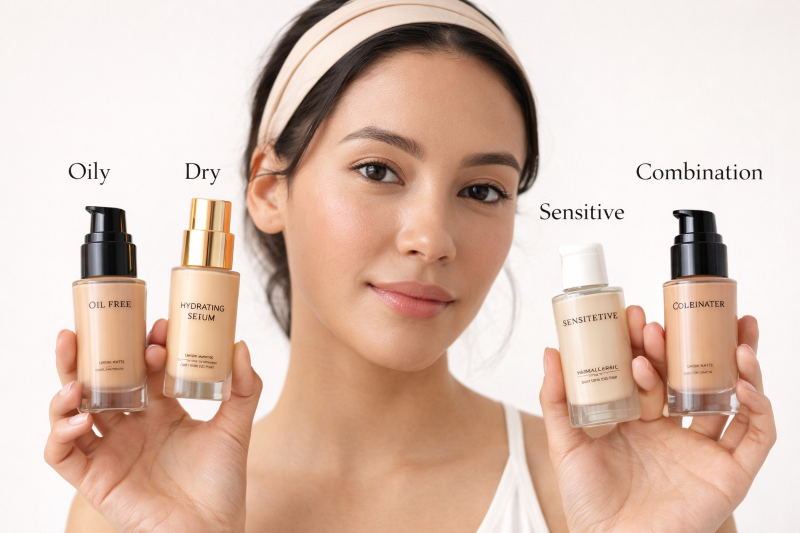
Makeup is not “one size fits all”. A foundation that looks flawless on dry skin can be a nightmare on oily skin, and a product that’s too matte can accentuate imperfections on sensitive skin. That’s why adapting your makeup to your skin type is essential not just for appearance, but also for skin health.
In this comprehensive guide you’ll discover:
how to correctly identify your skin type;
- which products work best for each type;
- what mistakes to avoid;
- simple tricks for makeup that looks good and is good for your skin.
How to identify your skin type
If you’re not sure what skin type you have, you can do a simple test:
Cleanse your face and apply nothing for 1–2 hours.
Observe how your skin feels:
- tight, “pulling” → dry skin;
- shiny in the T-zone → combination skin;
- shiny everywhere → oily skin;
- redness, burning appears → sensitive skin;
- seems balanced → normal skin.
Once you’ve identified your skin type, makeup becomes much easier.
Comparison table: skin type → recommended makeup products
Save this table for moments when you don’t know which products to choose.
| Skin Type | Recommended Foundation | Suitable Primer | Powder | Blush / Contour | Products to Avoid |
|---|---|---|---|---|---|
| Oily Skin | Oil-free, non-comedogenic, matte or semi-matte finish | Mattifying (T-zone) | Translucent, applied locally | Powder blush, matte contour | Creamy products, excessive highlighter |
| Dry Skin | Hydrating, luminous, fluid texture | Illuminating / hydrating | Spot application only (or none) | Creamy blush, stick | Excess powder, matte foundation |
| Combination Skin | Balanced, semi-matte | Mattifying in T-zone + hydrating on cheeks | T-zone only | Creamy or satin blush | Excessive setting all over face |
| Sensitive Skin | Hypoallergenic, fragrance and alcohol-free | Soothing, without aggressive silicone | Optional, very fine | Creamy blush, particle-free | Glitter, alcohol, fragrance |
| Normal Skin | Any formula suited to the season | Lightly hydrating | Optional | Any texture | Excess unnecessary products |
Makeup for oily skin
Oily skin produces excess sebum, which can make makeup “slide” or get trapped in pores.
What products to choose
- oil-free foundation, non-comedogenic;
- fluid or gel textures;
- mattifying primer;
- fine, translucent powder.
How to apply correctly
- cleanse your skin thoroughly;
- use a light moisturizer with quick absorption;
- apply foundation in thin layers;
- set only the T-zone.
What to avoid
- very creamy foundations;
- excessive highlighter;
- applying multiple layers of powder.
Makeup for dry skin
Dry skin needs hydration and products that provide comfort and luminosity.
What products are ideal
- hydrating foundation with luminous finish;
- illuminating primer;
- creamy blush;
- hydrating setting spray.
Useful tips
- hydrate your skin well before makeup;
- avoid powder all over your face;
- apply products with gentle tapping, not rubbing.
Common mistakes
- matte products;
- excess powder;
- lack of hydration before makeup.
Makeup for combination skin
Combination skin is the most common and the most “demanding”.
The correct approach
- different products for different zones;
- balanced foundation;
- powder only in the T-zone;
- blush and highlighter applied moderately.
Practical tip
You can use two types of primer:
- mattifying in the T-zone;
- hydrating on the cheeks.
Makeup for sensitive skin
Sensitive skin reacts quickly to unsuitable products.
What to look for on labels
- alcohol-free;
- fragrance-free;
- hypoallergenic;
- dermatologically tested.
How to apply
- as few products as possible;
- clean brushes;
- gentle movements.
What to avoid
- glittery products;
- aggressive exfoliation;
- excessive makeup.
Less is more — especially for sensitive skin.
Makeup for normal skin
Normal skin is balanced and easy to apply makeup on.
Recommendations
- keep your routine simple;
- adapt products seasonally;
- don’t overdo powder or matte products.
Even if it’s “easy to maintain”, don’t neglect skincare.
Makeup by season
✔ Summer
- light textures;
- SPF under makeup;
- transfer-resistant products.
✔ Winter
- hydrating formulas;
- avoid very matte products;
- focus on comfort.
Common mistakes regardless of skin type
- choosing foundation by color alone;
- applying makeup on unprepared skin;
- dirty brushes;
- ignoring the neck;
- lack of proper makeup removal.
Conclusion
Successful makeup doesn’t mean more products, but the right products. When you adapt your makeup to your skin type:
- it looks more natural;
- it lasts longer;
- it protects your skin.
Your skin doesn’t need compromises, it needs care.





Comments are closed.