
Basil is one of the world’s most beloved aromatic plants. Learn how to grow it successfully in your garden or on your balcony with this comprehensive guide covering planting, care, harvesting, and preservation.

How to Grow Basil: The Complete Guide for Garden and Pot Cultivation
Basil is one of the most beloved aromatic plants in the world. Its intense aroma instantly transforms dishes like salads, sauces, or pizza, and in other cuisines it is frequently used in soups, salads, or to flavor various dishes.
Beyond its delicious taste, basil is also an easy plant to grow, even for beginners. It can be grown both in the garden and in pots on a balcony or windowsill.
In this complete guide you will learn how to plant basil, what type of soil it prefers, how much light it needs, when to plant it, and how to care for it properly, so you can enjoy fresh leaves all summer long.
What is basil and why is it worth growing
Basil (Ocimum basilicum) is an annual aromatic plant native to tropical Asia, but very widespread in Europe. It is appreciated both for its intense aroma and its beneficial properties.
Among the advantages of growing basil are:
- grows quickly and is easy to maintain
- can be grown in pots or in the garden
- has antioxidant and antibacterial properties
- attracts pollinators such as bees
- helps repel certain insects
Also, fresh basil has a much more intense flavor than the dried variety bought from the store.
How to plant basil
When to plant basil
Basil is a cold-sensitive plant, so timing is important.
Recommended periods:
- March – April: sown in pots or seed trays indoors
- May – June: planting in the garden, after the risk of frost passes
Depending on where you are located, basil is usually planted after May 10–15, when nighttime temperatures are above 10°C.
At what depth to plant seeds
Basil seeds are small and should not be planted deep.
Recommended depth:
- 0.5 – 1 cm in soil
Steps for planting:
- Fill the pot or bed with loose soil.
- Scatter the seeds on the surface.
- Cover with a thin layer of soil.
- Water lightly with a spray bottle.
Germination usually appears in 5–10 days.
What type of soil basil prefers
Basil prefers a soil that is:
- loose
- well-drained
- rich in nutrients
- slightly acidic or neutral (pH 6–7)
An ideal mix for pots:
- 50% universal potting soil
- 30% compost
- 20% sand or perlite for drainage
In the garden, soil should be fertile and well-worked, without standing water.
How much light does basil need
Basil is a light-loving plant.
It requires:
- 6–8 hours of sun per day
It thrives best:
- on a balcony facing south or southeast
- in the garden, in sunny locations
Can it be planted in shade?
Basil can tolerate partial shade, but growth will be slower, and the aroma of leaves weaker.
In very hot areas, some afternoon shade can even be beneficial.
Ideal temperature for basil
Basil is a tropical plant, so it prefers warm temperatures.
Optimal temperatures:
- 20 – 30°C for growth
- minimum 10°C
It is very sensitive to frost.
At temperatures below 5°C, the plant can die quickly.
Therefore, if grown in pots, it is recommended to move it indoors in autumn.
How to grow basil in pots

Growing basil in pots is perfect for apartments or balconies.
Pot size
Basil develops a fairly extensive root system, so the container needs to be deep enough.
Recommended sizes:
| Container type | Size |
|---|---|
| Individual pot | 15–20 cm depth |
| Planter box | minimum 20 cm depth |
| Distance between plants | 15–20 cm |
If plants are too close together, they will compete for light and nutrients.
Watering basil in pots
Basil prefers soil that is consistently moist, but not waterlogged.
Simple rules:
- water 2–3 times a week in summer
- check if the top layer of soil is dry
- avoid watering the leaves
It is best to water in the morning.
Fertilizing basil
Basil can grow without fertilizer, but leaf production will be greater if it receives nutrients.
Suitable fertilizers:
- compost
- liquid fertilizer for aromatic plants
- nettle extract
Fertilize approximately once every 2–3 weeks.
How to grow basil in the garden

Basil grows very well in the garden, especially in sunny areas.
Distance between plants
For proper development:
- 20–30 cm between plants
This allows for air circulation and reduces disease risk.
Watering in the garden
Basil needs regular watering, especially during hot periods.
Recommendations:
- watering 2–3 times a week
- watering in the morning
- soil should remain slightly moist
How to harvest basil correctly
Correct harvesting stimulates plant growth.
Important rules:
- pinch leaves from the top
- do not take more than 1/3 of the plant
- pinch above a leaf node
This way, the plant will produce new branches and more leaves.
Why it’s good to pinch the basil tip
When the plant reaches approximately 15 cm in height, it is recommended to pinch its tip.
Benefits:
- stimulates branching
- produces more leaves
- plant becomes bushier
It is also good to remove flowers, because they reduce the aroma of leaves.
Common problems when growing basil
Leaves turn yellow
Possible causes:
- excess water
- lack of nutrients
- insufficient light
Leaves wilt
Can be caused by:
- temperatures too low
- dry soil
- insufficient watering
Insects appear on the plant
The most common are:
- aphids
- red spider mites
Solutions:
- rinsing leaves with water
- natural solutions with potassium soap
How long does basil live
Basil is an annual plant.
Lifespan:
- approximately 4–6 months
However, if you grow it in pots indoors, it can last up to 8–10 months.
Tips for a bountiful basil harvest
If you want aromatic leaves and plenty of them, keep these recommendations in mind:
- plant in very bright locations
- don’t let the soil dry out completely
- pinch the plant tip periodically
- remove flowers
- fertilize moderately
With minimal care, basil can become one of the most productive aromatic plants in your garden or on your balcony.
How to dry basil at home (3 simple methods)
If you have a bountiful basil harvest, you can preserve it very easily for winter. Dried basil retains much of its aroma and can be used in soups, sauces, pasta, or salads.
There are several simple methods by which you can dry basil at home.
1. Natural drying (classic method)

This is the traditional method, used for a long time for aromatic plants.
How to proceed:
- cut healthy basil stems
- rinse them gently and let them dry
- tie a few stems into a bundle
- hang them upside down in a well-ventilated place
It is important that the place be:
- dry
- well-ventilated
- protected from direct sunlight
Basil dries completely in 7–14 days.
2. Oven drying
If you want a quick method, you can dry basil in the oven.
Steps:
- rinse and dry the leaves
- place them on baking paper
- set the oven to 40–50°C
Leave the oven slightly open for ventilation.
Basil is dry in approximately 1–2 hours.
3. Food dehydrator drying
A food dehydrator is one of the best methods for aromatic plants.
Advantages:
- better aroma preservation
- drying is uniform
- the process is controlled
Ideal temperature for basil:
35–40°C
Leaves dry in approximately 4–6 hours.
How to store dried basil
After drying:
- crumble the leaves lightly
- store them in glass jars
- keep them in a dark and dry place
Dried basil retains its aroma for approximately 6–12 months.
The most popular types of basil
There are several varieties of basil, each with a different aroma and appearance. Some are better suited for cooking, while others are for decoration or gardening.
Sweet basil (Genovese)

It is the most well-known type of basil and the most used in Italian cuisine.
Characteristics:
- large and aromatic leaves
- sweet and intense flavor
- ideal for pesto and pasta
Purple basil

This type of basil is appreciated for its decorative appearance.
Characteristics:
- dark purple leaves
- slightly spicy aroma
- ideal for salads and culinary decoration
Thai basil

It is very popular in Asian cuisine.
Characteristics:
- slightly anise-flavored aroma
- purple stems
- narrower leaves
It is perfect for:
- Thai dishes
- Asian soups
- stir-fry.
Small-leaved basil (Greek basil)
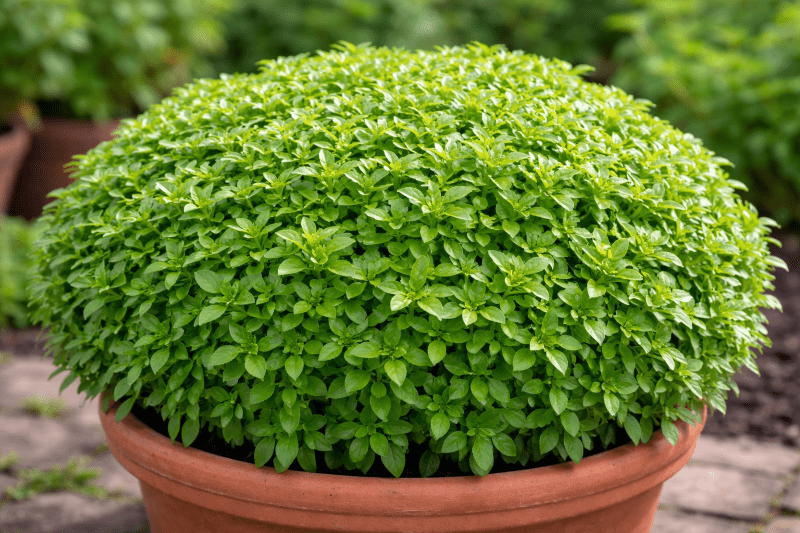
This variety has a compact appearance and is very suitable for pots.
Characteristics:
- small leaves
- dense growth
- intense aroma
It is ideal for:
- planters
- balcony
- windowsill.
Quick basil care guide
| Feature | Recommendation |
|---|---|
| Plant type | Annual aromatic plant |
| Light | 6–8 hours of sunlight per day |
| Optimal temperature | 20–30°C |
| Minimum temperature | 10°C |
| Soil | Loose, well-drained, rich in nutrients |
| Soil pH | 6 – 7 |
| Seed planting depth | 0.5 – 1 cm |
| Distance between plants | 20–30 cm |
| Watering | 2–3 times per week in summer |
| Fertilizing | every 2–3 weeks |
| Pot height | minimum 15 cm |
| Harvesting | when the plant is over 15 cm |
| Frost resistance | not resistant |
Frequently asked questions about growing basil
How quickly does basil grow?
Basil germinates in about 5–10 days after planting, and the first leaves can be harvested in 3–4 weeks, depending on temperature and light.
Can basil be grown in an apartment?
Yes. Basil grows very well in an apartment if it has enough light. Ideally, it should be placed:
– on a south or east facing window sill
– in a place with at least 6 hours of light per day
How often should basil be watered?
Basil prefers slightly moist soil, but does not tolerate excess water.
Typically:
– summer: 2–3 waterings per week
– spring/autumn: 1–2 waterings per week.
It’s a good idea to always check if the top layer of soil is dry before watering.
Why does basil bloom and should the flowers be removed?
Basil begins to produce flowers in the summer. When the plant blooms:
– the leaves become less aromatic
– the growth of the leaves slows down
That is why it is recommended to cut the flowers as soon as they appear.
Does basil grow back after being cut?
Yes. Basil grows very well after pruning. If you cut the leaves above a leaf node, the plant will produce two new branches, which makes it more bushy.
Can basil survive winter?
In the garden, basil does not survive the winter, as it is an annual plant and sensitive to cold.
If grown in a pot, it can be moved indoors before the cold weather arrives.
Can basil be grown from a plant bought from the supermarket?
Yes, but these plants are often very crowded in pots. It is recommended to:
– separate them into several pots
– use fresh soil
– give them more space for their roots
This way the plant will become more vigorous and produce more leaves.
Conclusion
Basil is an easy-to-grow, versatile herb that is great for the kitchen. Whether you choose to plant it in your garden or in a pot on your windowsill, this plant only needs a few simple conditions: plenty of light, well-drained soil, and regular watering.
In return, it will reward you with fresh, flavorful, and healthy leaves all summer long.
If you love to cook or have herbs on hand, basil is definitely a great choice for your garden or balcony.



Comments are closed.