
Parsley is one of the most versatile herbs in the kitchen, gracing soups, salads, sauces, and garnishes with its fresh aroma and nutritional benefits. The good news? It grows beautifully at home—both in gardens and pots—making it perfect for any gardener.
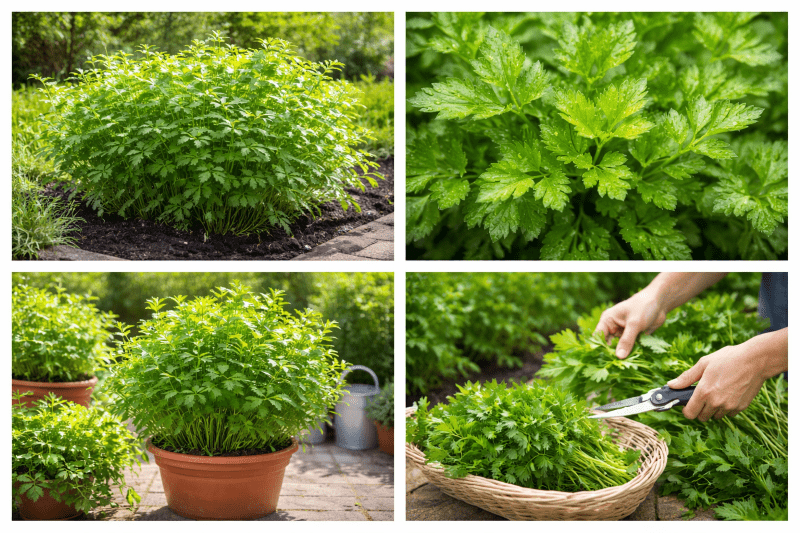
How to Grow Parsley: Complete Guide for Garden & Potting
Parsley is one of the most popular aromatic plants in the kitchen. It features in soups, salads, sauces, and garnishes, and is prized for both its fresh aroma and nutritional benefits.
The great news is that parsley can be grown very easily at home. It thrives both in the garden and in pots on balconies or windowsills, and the leaves can be harvested over a long period.
In this complete guide you’ll discover:
- how to plant parsley
- what type of soil it prefers
- how much light and water it needs
- how to harvest correctly
- how to store it for winter
If you’d like to discover other aromatic plants you can grow at home, also read our Complete Guide to Aromatic Plants.
What is Parsley and Why It’s Worth Growing

Parsley (Petroselinum crispum) is an aromatic plant native to the Mediterranean region, but widely distributed across Europe.
There are two main varieties:
- flat-leaf parsley (the most aromatic)
- curly parsley (more decorative)
Characteristics:
- intensely green leaves
- fresh aroma
- rich in vitamins and minerals
Advantages of growing parsley:
- grows easily
- can be grown in pots
- tolerates cooler temperatures
- produces leaves for several months
When to Plant Parsley
Parsley can be planted quite early in the season.
Recommended periods:
- March – April
- August – September (for autumn harvest)
Parsley seeds germinate more slowly than other aromatic plants.
Germination takes approximately:
2–4 weeks
To speed up the process, seeds can be soaked in water for 12–24 hours before planting.
What Type of Soil Does Parsley Prefer
Parsley prefers soil that is:
- rich in nutrients
- loose and aerated
- well-draining
- slightly moist
Ideal potting mix:
- 50% universal potting soil
- 30% compost
- 20% perlite or sand
The soil should be deep enough since the roots can become quite long.
How Much Light Does Parsley Need
Parsley prefers moderate light.
It needs approximately:
4–6 hours of light per day
It develops well in:
- partial sun
- semi-shade
This is one of the aromatic plants that adapts well indoors.
How to Grow Parsley in Pots

Parsley grows very well in pots or planters.
Pot Size
Recommended dimensions:
- diameter: 15–20 cm
- depth: 20 cm
It’s important that the pot has drainage holes.
Watering Parsley
Parsley prefers consistently moist soil.
Rules:
- water 2–3 times per week in summer
- don’t let the soil dry out completely
- avoid excess water
Regular watering helps the plant produce tender leaves.
How to Grow Parsley in the Garden

In the garden, parsley can produce a large quantity of leaves.
Recommended spacing between plants:
15–20 cm
Advantages of growing in the garden:
- more vigorous plants
- greater production
- harvest over an extended period
Does Parsley Survive Winter?
Parsley tolerates cooler temperatures better than many aromatic plants.
It can withstand approximately:
-5°C
In regions with harsher winters, the plant can be protected with:
- mulch
- agricultural film
If grown in a pot, it can be moved indoors.
How to Harvest Parsley
Correct harvesting helps the plant produce new leaves.
Rules:
- cut the outer leaves
- use clean scissors or a knife
- don’t remove more than 30% of the plant
Regular harvesting stimulates growth.
How to Store Parsley
There are several simple methods.
Freezing
This is one of the best methods.
Leaves can be frozen:
- in bags
- in ice cubes with water or oil
Drying
Leaves can be dried:
- naturally
- in the oven
- in a dehydrator
However, parsley loses some of its aroma through drying.
Common Problems with Growing Parsley
Leaves Turn Yellow
Possible causes:
- soil too dry
- nutrient deficiency
- excess water
Plant Grows Very Slowly
Can be caused by:
- low temperatures
- lack of light
- nutrient-poor soil
Benefits of Parsley
Parsley is highly nutritious.
It’s rich in:
- vitamin C
- vitamin K
- iron
- antioxidants
It’s frequently used in:
- soups
- salads
- garnishes
- green smoothies


Comments are closed.