
Master the art of winter plant watering with this comprehensive guide. Learn when to water, how much, and which mistakes to avoid to keep your indoor plants healthy all season long.
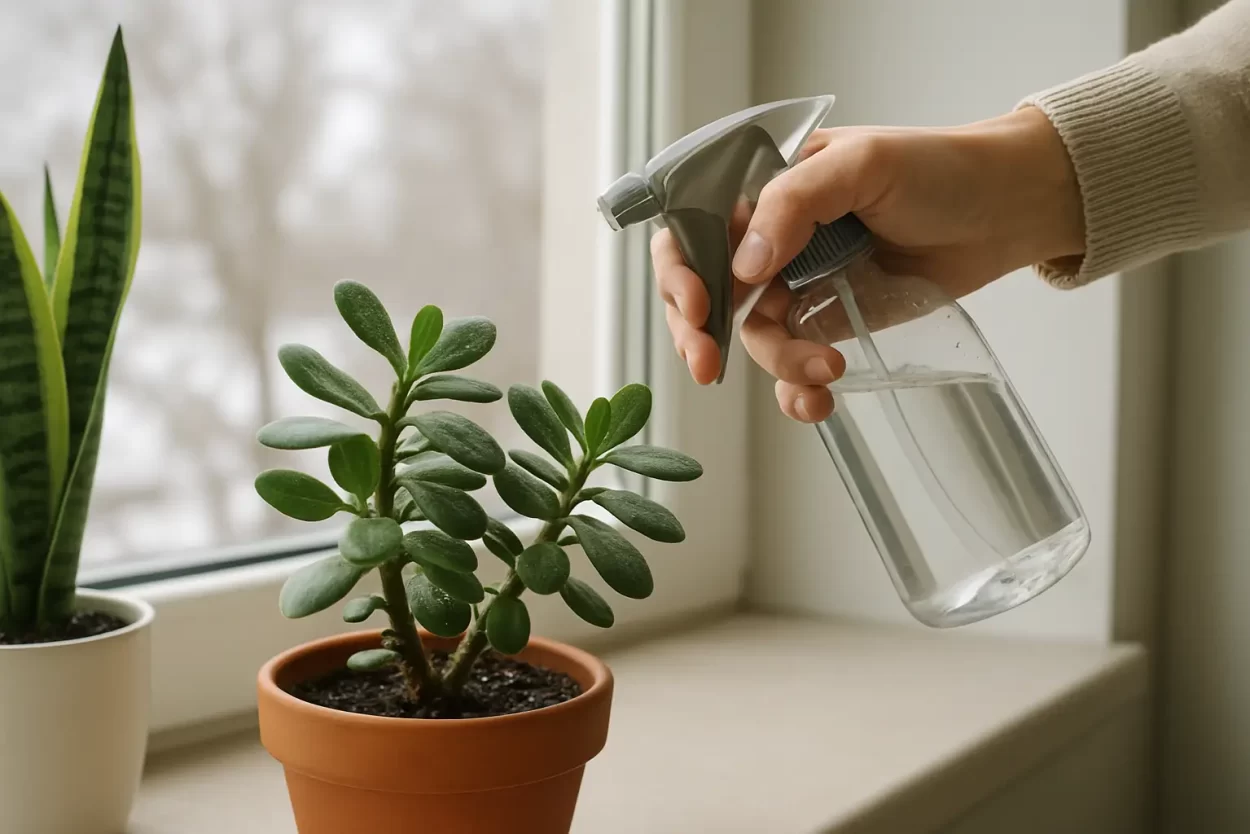
How to Water Indoor Plants Correctly in Winter: A Complete Guide
In winter, most indoor plants don’t die “out of nowhere.” They die from too much care—meaning too much water, at a time when light is scarce, air is dry, and soil dries differently than in summer. If you’ve ever seen yellowing leaves, soft stems, or mold on the surface of a pot, you’ve already witnessed the effect.
Below you’ll find a practical guide on how to water indoor plants correctly in winter, with simple rules, but also with nuances (because “it depends” really does matter here).
Why watering changes in winter (and why the pot deceives you)
In winter, most plants slow their growth. Some enter a semi-dormant state: they no longer produce new leaves or grow much more slowly. That means they use less water.
At the same time, natural light decreases, and evaporation from the soil is slower. If you also have a decorative pot without drainage or soil that’s too compact, water sits “cold” around the roots. The classic result: suffocated roots, then rot.
What misleads you is that the air in your home becomes drier because of heating. Leaves appear dehydrated (brown tips, wilted appearance), and the instinct is to water. Sometimes the correct solution isn’t more water, but more humid air or less frequent but more effective watering.
The basic rule: water based on soil, not the calendar
The question “how often do I water in winter?” has a good answer only if you look at the soil. The calendar helps you only as a reference.
Quick check: insert your finger 2-3 cm into the soil. If this layer is still moist and cool, don’t water. If it’s dry, watering may be justified. For large pots, the finger test might not be enough—the soil can be wet deep down even if the surface seems dry.
A very practical trick is the “pot weight test.” Lift the pot right after proper watering (once excess has drained), then lift it again a few days later. The difference is noticeable. Over time, you develop the reflex: light pot = drier soil.
If you want a simple tool, a soil moisture meter (probe type) helps with large pots or sensitive plants, but it’s not essential. Important: don’t rely on the surface. In winter, the surface sometimes dries faster than the middle of the pot.
How to water indoor plants correctly in winter, step by step
Good watering in winter doesn’t mean “a little, often.” In many cases, that’s exactly what creates problems: constant moisture, stressed roots.
Correct watering looks more like this: water rarely, but thoroughly, then let the soil breathe between waterings. Pour water slowly until it starts draining through the drainage holes. Wait 10-15 minutes and empty the saucer or pot cover. Don’t let the plant sit with its roots in water.
If you have a decorative pot without holes, move the plant to a plastic pot with drainage (inside), so you can control the drainage. It’s one of the simplest changes that prevents 80% of winter “dramas.”
For plants that prefer slightly moist soil (for example, ferns), it doesn’t mean the soil should be waterlogged. It just means you don’t let the substrate dry out completely. Still, the soil test guides you.
What type of water to use in winter
In winter, two frequent problems appear: water that’s too cold and water that’s too hard.
Ideally, use water at room temperature. Very cold water can shock the roots, especially if the plant sits near a cold window. If your tap water is heavily chlorinated or hard, you can leave it in an open bottle for a few hours. It’s not magic, but it helps stabilize the temperature and, sometimes, reduces the chlorine smell.
Some plants are more sensitive to salts (calathea, maranta, some dracaena) and can develop brown tips more easily. In that case, you can alternate with filtered water or demineralized water (not always, just occasionally), but keep in mind that the main problem in winter remains overwatering, not water perfection.
Signs that you’re watering too much (and how to tell them from underwatering)
Excess water in winter has a very clear set of signals, but they can be confused with “thirst.”
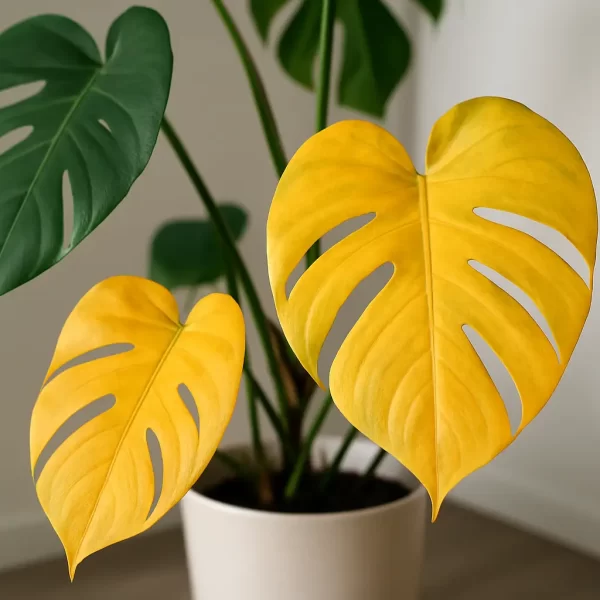
If leaves turn yellow and fall, stems become soft, and the soil smells damp or moldy, you’re most likely watering too often. Similarly, if you notice small gnats around the pot—they love constantly moist substrate.
Lack of water shows more through wilted and dry leaves, crispy edges, soil pulling away from the pot’s rim, and water passing quickly past the substrate when you water (a sign it’s compacted or dried unevenly).
The tricky part: you can see wilted leaves from excess water too. The reason is simple: roots can’t absorb water if they’re damaged. That’s why checking the soil is more reliable than “reading” the leaves.
Factors that change watering frequency (it’s not the same for all plants)
In winter, two plants can need watering at completely different intervals even if they sit in the same room. It matters:
Light: near a bright window (south, west), soil dries faster than in a darker corner.
Temperature: near a heater, drying is faster, but that doesn’t automatically mean more water. Sometimes it means moving away from the heat source and improving humidity.
Pot type: terracotta “breathes” and dries faster than plastic or glazed ceramic.
Soil: heavy soil that compacts retains water for a long time. An aerated mix (with perlite, bark, fibers) drains better and in winter is more forgiving.
Plant and pot size: large pots hold moisture longer. In winter, oversaturation often happens here because we water “like summer.”
Seasonal exceptions: succulents, cacti, orchids, ferns
If you have many types of plants, “batch” watering in winter is a recipe for problems.
Succulents and cacti typically need very little water in winter. The soil should dry completely between waterings, sometimes even stay dry for several days. If they’re kept cool and have weaker light, waterings become rare. Here, excess is much more dangerous than lack.
Orchids (phalaenopsis) are watered differently: when roots turn gray-silver and the substrate is almost dry. If you water them, do it in the morning and drain all water completely, so it doesn’t sit cold overnight. If water gets into the “crown” (the center of leaves) and stays there, the rot risk increases.
Ferns prefer constant humidity but don’t tolerate waterlogging. If the soil is too wet in winter, spots and blackened leaves appear quickly. For them, slightly more humid air helps more than frequent watering.
Winter mistakes that wreck your plants, even if “you don’t water much”
The first mistake is watering “a little” many times. It seems safe, but keeps the top always moist and doesn’t encourage roots to breathe. Better to water properly and rarely, with drainage.
The second mistake: leaving water in the saucer. In winter, one day of roots sitting in water can do more damage than a week of delayed watering.
The third: moving the plant next to a heat source “to keep it warm.” The heater dries leaves, but the soil can stay wet underneath. The result is the perfect combination for confusion: dry leaves up top, too-wet roots below.
The fourth: not adjusting watering when days get darker. In December-January, many plants need the rarest watering of the year. In February-March, as light increases, the rhythm changes again.
What to do if you’ve watered too much (quick intervention, no panic)
If you’ve watered once too much, the first step is to immediately empty the water from the saucer and place the plant in a brighter, warmer spot (but not touching the heater), so it dries gradually.
If the soil is saturated, smells bad, or the plant goes limp, you need to check the roots. Carefully remove the plant, remove the very wet substrate, and cut away brown, soft roots or ones that come off easily. Repot in more aerated substrate and a pot with good drainage. After that, only water immediately if very few roots remain and the substrate is completely dry—often it’s better to wait a few days.
If you want to build a good habit for the season, keep a mini-rule: “drainage, check, then water.” You can find other quick guides for home care that follow the same idea—simple steps, no guessing.
A realistic winter rhythm (so you don’t stress)
Instead of asking yourself daily if plants need water, set yourself a check routine, not a watering routine. For example, check the soil once a week for common plants and every 10-14 days for succulents, then water only what needs it.
If you have many pots, mentally note which are “thirsty” (ferns, fittonia) and which are “economical” (sansevieria, zamioculcas). In winter, economical plants teach you patience best.
Think of watering as a decision, not a repetitive chore: if the soil is still moist, delay without guilt. Indoor plants get through winter much better with a little lack than with too much water—and once you get the rhythm, you’ll see that the cold season becomes, actually, the easiest period for maintenance.

Comments are closed.