Your foundation settles into fine lines not because of the product itself, but due to dehydration, wrong formula selection, or incorrect application. Learn the real causes and proven solutions.
Why Does Foundation Settle Into Fine Lines? Real Causes and Solutions
You’ve applied a good foundation, maybe even a premium one, and after a few hours you notice it’s settled into fine lines around your eyes or mouth? You’re not alone.
Most of the time, the problem isn’t the product itself, but:
- skin preparation,
- choosing the wrong formula for your skin type,
- incorrect application,
- using too much product.
In this guide we clearly explain why foundation settles into fine lines and what you can do to prevent it.
1. Your Skin Is Dehydrated (Even if It’s Oily)
One of the most common reasons is dehydration.
Even oily skin can be dehydrated. When your skin isn’t well hydrated:
- foundation doesn’t adhere evenly,
- it settles into fine lines,
- it emphasizes skin texture.
✅ Solution:
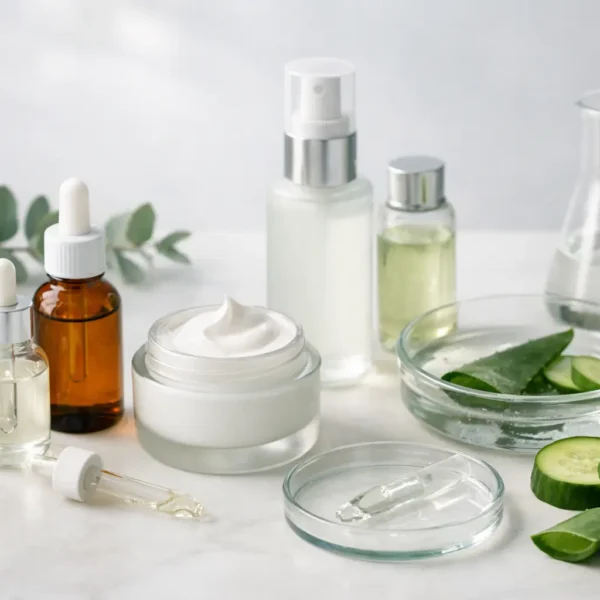
- Apply a moisturizer suited to your skin type.
- Wait 5–10 minutes before applying makeup.
- Use a hydrating primer if you have dry or mature skin.
2. The Formula Isn’t Right for Your Skin Type
A very matte foundation on dry skin will emphasize lines.
A too-creamy foundation on oily skin can shift into creases.
Example:
- Estée Lauder Double Wear Stay-in-Place is very long-wearing, but on dry skin without proper preparation it can highlight lines.
- Maybelline Fit Me Matte + Poreless is excellent for oily skin, but can look dry on delicate areas.
👉 Rule: the formula should complement your skin, not force it.
3. You’re Applying Too Much Product
Layer upon layer = product that has nowhere to set.
Especially around the eyes, the amount should be minimal.
✅ Solution:
- Apply a thin layer.
- Add concealer only where needed.
- Tap with a damp sponge to blend.
4. You’re Not Setting Your Makeup Correctly
If you use too much powder:
- it creates a dry effect,
- lines become more visible.
If you don’t set at all:
- the product can shift into creases.
✅ Solution:
- Apply fine powder only in areas prone to movement (under eyes, T-zone).
- Avoid thick layers.
5. Incorrect Application
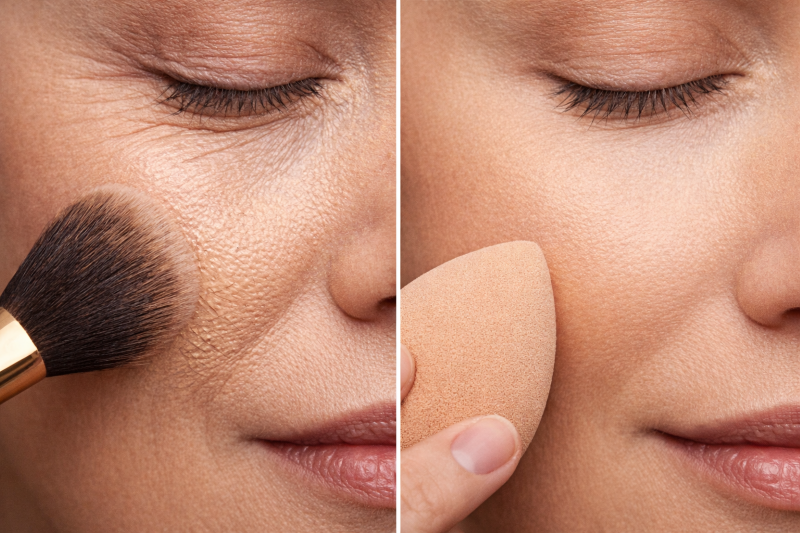
Rubbing while applying can push the product into lines.
✅ Correct Method:
- Apply by tapping.
- Use a damp sponge or dense brush.
- At the end, press gently with a clean sponge to blend.
6. Foundation Oxidizes or Is Too Dry
Some formulas “tighten” once they dry completely.
Example:
- Revlon ColorStay Foundation has strong hold – if you apply too much, it can emphasize texture.
The solution might be:
- a hydrating setting spray,
- a better-suited primer,
- or choosing a more fluid formula.
How to Apply Foundation Correctly to Avoid Settling Into Fine Lines
Step 1 – Hydration
Lightweight serum + moisturizer suited to your skin type.
Step 2 – Primer (Optional)
For mature skin or visible texture.
Step 3 – Thin Layer
Apply a small amount of product and build coverage only where needed.
Step 4 – Minimal Setting
Only in necessary areas.
Common Mistakes
❌ Applying foundation directly on dry skin
❌ Using the same formula all year round
❌ Aggressively blending the product
❌ Using too much concealer under the eyes
Who Experiences This Problem Most Often?
- People with mature skin
- People with dehydrated skin
- Heavy makeup with full coverage
- Areas with movement (eyes, mouth)
Important: fine lines are normal. Foundation doesn’t create them – it only emphasizes them if applied incorrectly.
FAQ – Frequently Asked Questions
Shouldn’t expensive foundation ever settle into lines?
No. Even a premium product applied incorrectly can shift into lines.
Does primer completely solve the problem?
It helps, but it doesn’t replace hydration.
Can I use less foundation and more concealer?
Yes, this is a very good strategy.
Does setting spray help?
Yes, especially hydrating varieties.
Conclusion
If your foundation settles into fine lines, it doesn’t automatically mean it’s a bad product.
Most of the time it comes down to:
- lack of hydration,
- unsuitable formula,
- incorrect application,
- excess product.
Successful makeup starts with properly prepared skin.