Yellow leaves on your Monstera signal something’s off with care routine—usually watering, light, or drainage. Learn the real causes and simple fixes to bring your plant back to vibrant health.
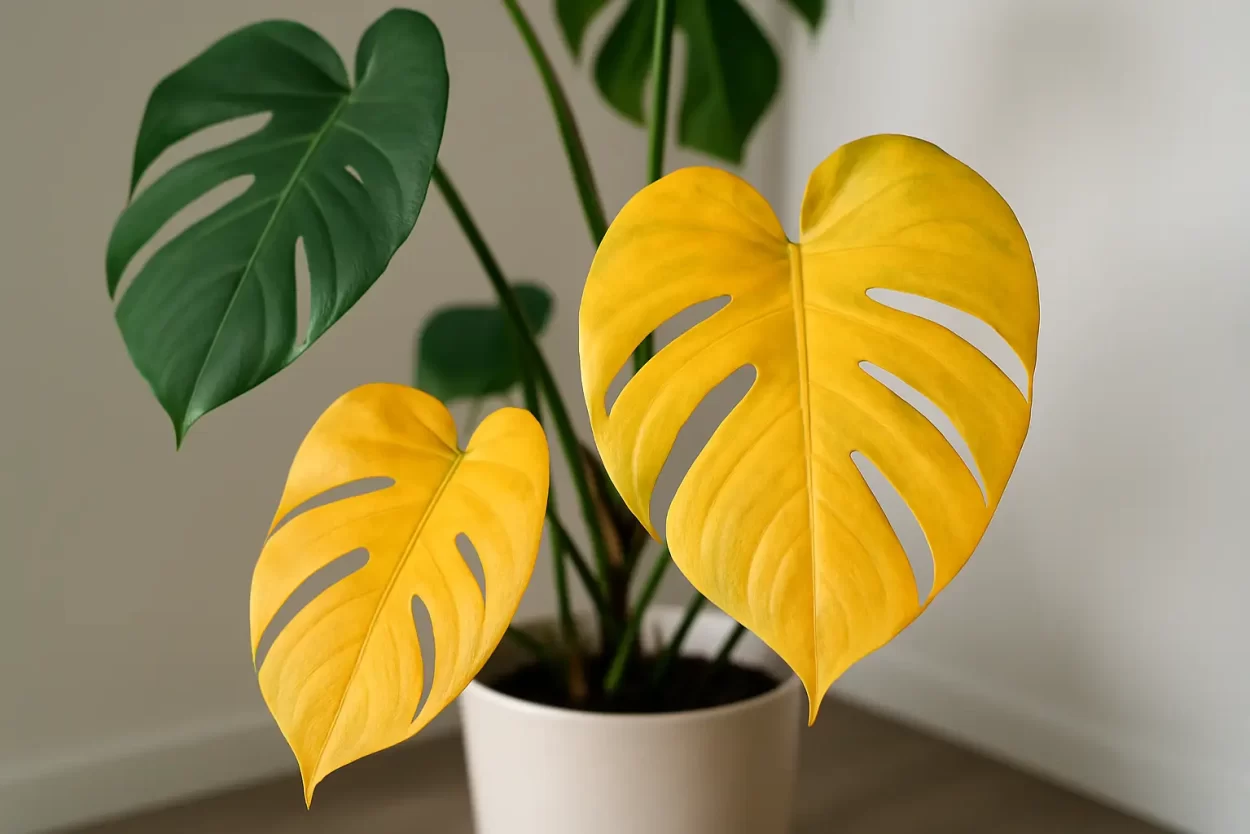
Monstera with Yellow Leaves: Causes and Solutions for Healthy Growth
You’re looking at your Monstera and notice that one (or more) leaves have started turning yellow. It’s not the kind of “drama” that’s solved with an extra watering. Most often, it’s a clear signal that something in its routine doesn’t fit—and if you act quickly, the plant will bounce back without major losses.
Monstera leaves turning yellow – what do I do, exactly?
Before you change everything, do a quick check, in this order. It helps you identify the real cause, not just the symptom.
First, look at how many leaves are affected and where: the lower leaves (the oldest ones) that occasionally turn yellow can be normal, especially if the plant is growing actively and putting out new leaves. On the other hand, rapid yellowing on multiple leaves or on young leaves is almost always a care issue.
Then touch the soil with your finger at 3-5 cm deep. If it’s wet, cold, and “sticky,” it’s a sign you’ve watered too often or the pot doesn’t drain. If it’s dusty, dry, and pulling away from the pot edges, you’ve skipped too many waterings.
Finally, look at the light: Monstera loves plenty of light, but filtered. If it’s in direct sunlight (especially at midday), it can yellow from sunburn and stress. If it’s in a dark corner, leaves can yellow slowly, and the plant becomes sparse.
The most common cause: incorrect watering
Overwatering (and damaged roots)
With Monstera, overwatering is the “champion” for yellow leaves. When soil stays wet for days on end, roots don’t get oxygen and start to suffer. The plant can’t absorb water and nutrients properly, and leaves turn yellow, sometimes with a soft appearance.
What to do now: stop watering until the top 5-7 cm of soil dries out well. If the pot is heavy and the soil smells damp or moldy, take the plant out and check the roots. Healthy roots are firm and light in color; affected ones are soft, dark, and may smell unpleasant. Cut away the compromised parts with clean scissors and repot in fresh, aerated soil.
Underwatering (dehydration)
Yes, lack of water can also yellow leaves, especially if the plant has been completely dry for a long time. Usually, yellowing comes with slightly soft leaves, brown edges, and a plant that droops.
What to do now: water thoroughly until water runs through the drainage holes, then let the pot drain completely. Don’t return with water the next day just to “be safe.” Monstera prefers infrequent but proper waterings.
Drainage and pots: the detail that changes everything
You can water perfectly and still have yellow leaves if the pot has no holes or if water sits in the saucer. Monstera needs real drainage, not “approximately.”
If the saucer fills up, empty it after 10-15 minutes. If the pot is decorative (pot cover) and holds moisture, remove the inner pot to drain. Overly compact soil (too much peat, heavy soil) retains water and suffocates roots.
A better mix is an aerated one, with orchid bark, perlite, and coconut fiber or quality universal soil. The idea is simple: water passes through, air circulates.
Light: too much or too little
Monstera in nature grows under the tree canopy, meaning it gets strong light but filtered.
If leaves have yellow patches that become brown and dry, especially on the side facing the window, it may be direct sun. Move it 1-2 meters from the window or use a curtain.
If leaves yellow uniformly and growth stalls, it may be too little light. Move it closer to a bright window (east or west is often ideal). In winter, many plants start looking tired precisely because of weak light, not just watering issues.
Nutrients: when they’re missing and when there’s too much
A Monstera that hasn’t been fertilized for months can yellow, especially if the soil is old and depleted. On the other hand, too much fertilizer burns roots and produces yellow leaves with brown tips.
If you haven’t fertilized at all: during the growing season (spring-summer), use a balanced fertilizer at half the recommended dose, once every 2-4 weeks. If you’ve fertilized aggressively: stop fertilizing and flush the soil with abundant watering (letting water run through the pot), then return to a gentler rhythm.
Water matters too. If you have very hard water (mineral-rich), minerals accumulate in the soil over time and the plant reacts with dull, yellow leaves. It helps to occasionally water with filtered water or water left in an open container for 24 hours.
Temperature and air currents
Monstera doesn’t like shocks. If it’s near a radiator, air conditioner, or a door that opens often in winter, leaves can yellow from thermal stress.
Keep a relatively constant temperature (ideally above 18°C) and protect leaves from cold drafts. A typical sign: a leaf yellows after a very cold night near the window.
Pests: inspect leaves like a “detective”
When yellowing seems illogical, look carefully at the underside of leaves and at nodes (where leaves emerge). Mealybugs, spider mites and thrips are the most common.
Classic signs: tiny dots, fine webs (mites), silvery spots (thrips), “cotton” in corners (mealybugs). Pests suck sap, the leaf loses color, and over time, yellows.
What to do: isolate the plant from others, wipe leaves with a damp cloth, and apply appropriate treatment (insecticidal soap or horticultural oil, per instructions). Repeating every 7-10 days is important, because eggs can survive the first round.
Old leaves: when yellowing is normal
If Monstera is healthy, puts out new leaves, and only one of the lowest leaves slowly yellows, it may simply be the natural cycle. The plant is “moving” energy toward growth.
In this case, don’t rush to change watering or location. Wait to see if a pattern emerges (multiple leaves, young leaves, rapid yellowing). You can trim a completely yellow leaf with clean scissors, as close to the stem as possible.
Quick rescue steps (without panicking)
If you need a simple plan for the next 7-10 days, follow this logic: reduce risks, stabilize routine, then fine-tune.
Start by checking moisture in the pot and drainage. If it’s too wet, let the plant dry out and make sure it’s not sitting in water in the saucer. If it’s too dry, water properly once, then return to checking the soil before each watering.
Move it to a place with good light but no direct sun. Dust the leaves (dust reduces photosynthesis) and inspect for pests. Only after you’ve ruled out watering, light, and pests does it make sense to think about fertilizing or completely changing the soil.
When you definitely need to repot
Repotting isn’t always the answer, but it becomes necessary in a few clear situations: soil that stays wet for very long, unpleasant smell, black or soft roots, or a pot full of tangled roots.
Choose a pot 2-4 cm larger in diameter, not a “big jump.” A pot that’s too large holds excess water and brings you back to the original problem.
If you want more practical guides for apartment plants and home care, you’ll find similar articles on Ruki.ro.
The question that helps most
If Monstera leaves are yellowing, what did you do differently from last week? Often, the answer is there: an extra watering “because it was hot,” moving it near a window, a radiator turning on, a vacation and then overwatering to catch up.
Monstera doesn’t demand perfection, just consistency. When you nail its rhythm—filtered light, watering only when soil is actually dry at the surface, good drainage—yellow leaves become an exception, not a routine. And that’s the kind of peace you deserve in a home full of green.