
Master fluffy pancakes in just 15 minutes with this foolproof recipe. Learn the exact techniques, common mistakes to avoid, and clever adjustments for perfect results every time.
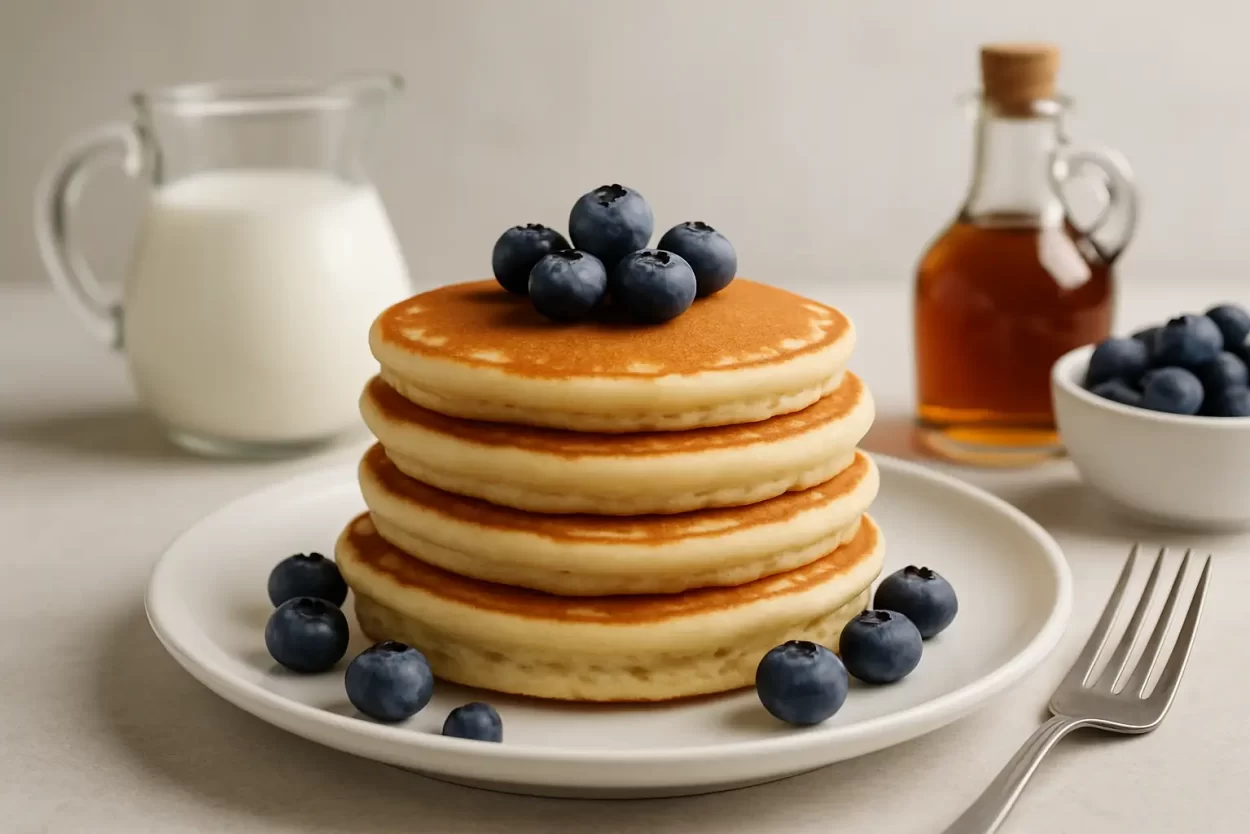
Fluffy Pancakes in 15 Minutes: Simple Recipe for Perfect Results Every Time
The morning your pancakes come out flat follows a pattern: you overmixed the batter, the pan was too hot, or the leavening agent didn’t do its job. The good news is that for tall, soft, golden pancakes you don’t need fancy mixes or complicated techniques. You need a reliable recipe and 3-4 small habits that make all the difference.
Fluffy Pancakes Simple Recipe (Your Reliable Base)
The recipe below is designed for consistent results, with ingredients you’ll find in any kitchen. You’ll get a batter thick enough to rise beautifully, but not so dense it stays raw in the center.
Quantities for approximately 8-10 pancakes (10-12 cm diameter):
- 200 g all-purpose flour (approx. 1½ cups)
- 2 tablespoons sugar
- 2 teaspoons baking powder (level)
- ½ teaspoon baking soda
- ½ teaspoon salt
- 2 eggs
- 300 ml buttermilk (or thin yogurt + a bit of water), at room temperature
- 40 g melted and cooled butter (or 3 tablespoons oil)
- 1 teaspoon vanilla extract (optional)
Helpful note: the combination of baking powder + baking soda + buttermilk is one of the simplest methods for fluffy pancakes. The baking powder provides volume, while the baking soda reacts with the acid in the buttermilk and helps create an airy texture.
How to Prepare Them Correctly, Step by Step
1) Mix the Dry and Wet Ingredients Separately
In a large bowl, combine the flour, sugar, baking powder, baking soda, and salt. In another bowl, lightly beat the eggs, then add the buttermilk, melted butter, and vanilla.
When you pour the wet ingredients over the dry ones, stir just until you don’t see any dry flour. Don’t aim for a perfectly smooth batter – small lumps are fine. If you keep stirring, you develop the gluten and pancakes become elastic and flat.
2) Let the Batter Rest for 5-10 Minutes
This brief pause allows the flour to hydrate and makes the batter more stable. In that time, the baking powder starts to work, and you get a thicker, more “pourable” batter that’s less temperamental in the pan.
3) Control the Pan Temperature
Heat a non-stick pan over medium heat. If your stove burns hot, stick with medium-low. A simple test: sprinkle a little water – the droplets should dance gently, not evaporate instantly like on a hot griddle.
Grease with a thin film of butter or oil, then wipe away the excess with a paper towel. Too much fat browns the outside before the inside has a chance to rise.
4) Pour and Don’t Rush the Flip
Use a small ladle or measuring cup (about 60-70 ml each). When bubbles appear on the surface and the edges look set (usually after 1:30-2:30 minutes), flip just once. Let them cook for another 1-2 minutes.
The rule that saves you: if you flip them 2-3 times, you lose the air in the batter and they deflate.
Why They’re Not Fluffy: The Most Common Mistakes
If you want consistent results, it’s worth knowing what ruins them most often. It’s usually not bad luck – it’s one of the situations below.
You’re Overmixing
Pancake batter isn’t like cake batter. You want minimal mixing to keep air in the mixture. When you stir too much, pancakes come out denser and more uniform, but not fluffy.
Your Ingredients Are Too Cold
Buttermilk straight from the fridge + warm butter can “curdle” the mixture or slow down the rising reactions. Let the dairy sit out for 10-15 minutes on the counter, and let the melted butter cool.
Your Baking Powder Is Old
If the packet’s been open for months, it loses its power. A typical sign: the batter looks fine, but pancakes stay thin. If you’re unsure, replace the baking powder. It’s one of the cheapest “fixes.”
The Pan Is Too Hot
The outside browns quickly, the inside stays raw, and you end up pressing them with the spatula (flattening them). Better to go slower and steady – medium heat, not high.
Quick Adjustments, Depending on What You Have
The base recipe is solid, but sometimes it really depends on what you have in your fridge. You can adapt without ruining the texture if you follow the logic: you need acid (for the baking soda) and a batter that’s neither too thin nor too thick.
If You Don’t Have Buttermilk
You can use plain yogurt mixed with a bit of water until it’s like thicker milk. If you only have regular milk, add 1 tablespoon lemon juice or vinegar to 300 ml milk and let it sit for 5 minutes. It’s not identical to buttermilk, but it works well.
If You Want Lighter Pancakes
You can replace the butter with oil and reduce the sugar to 1 tablespoon. The texture stays fluffy, but the flavor will be more neutral. This really comes down to taste – butter brings that “breakfast” aroma, oil is more subtle.
If You Want a Whole Wheat Version
Replace only 1/3 of the all-purpose flour with whole wheat flour. If you use 100% whole wheat, pancakes tend to come out denser. Compensate with 1-2 extra tablespoons of buttermilk and a longer rest (10 minutes).
Perfect Texture: How to Get Thickness Without Raw Centers
Very thick pancakes look impressive, but if you overdo the consistency, the center can stay “wet.” The solution isn’t to keep them on high heat longer, but to fine-tune.
The ideal batter flows slowly from the ladle and settles into a circle on its own, without spreading too much. If it spreads like a crêpe, it’s too thin – add 1-2 tablespoons of flour and stir briefly. If it sits like paste and doesn’t level out, it’s too thick – add 1-2 tablespoons of buttermilk.
And one more simple trick: after you flip the pancakes, you can cover the pan for 30-45 seconds. This lets the steam finish cooking the inside, especially if you make them larger.
Serving Ideas That Don’t Complicate Your Morning
Fluffy pancakes are good and simple on their own, but they quickly become a complete breakfast when you combine sweet with something hearty.
For a classic version, go with butter and honey or syrup, plus fruit (bananas, strawberries, blueberries). If you want something more balanced, try Greek yogurt and fruit, or peanut butter with banana slices. For those who prefer less sweet, they surprisingly pair well with fresh cheese and tangy jam.
When cooking for family, it’s useful to keep pancakes warm in the oven at 80-90°C on a tray while you finish the rest. Don’t cover them tightly – they’ll get soggy. Just leave them in a warm space.
Can They Be Made Ahead? Yes, With Two Rules
If you want to save time during the week, pancakes are great for prep-ahead. Let them cool completely, then place them in a baking dish with parchment paper between layers.
They’ll keep in the fridge for 2-3 days. In the freezer, up to 2 months. To reheat, a dry pan over low heat works beautifully, and for speed you can even use the toaster (if they fit). The microwave heats them quickly, but can make them softer – it depends what you prefer.
Quick Checklist for Getting It Right the First Time
If you want to skip trials and adjustments, remember the winning formula: minimal mixing of the batter, 5-10 minutes rest, medium heat, and just one flip. From there, you just calibrate the consistency with 1-2 tablespoons of flour or buttermilk, without reinventing the recipe.
If you like this kind of recipe explained clearly, with straightforward steps and solutions to common mistakes, you’ll find more ideas in the Recipes section.
Once your pancakes come out fluffy, it’s not luck – it’s a sign you’ve found the rhythm. Keep the same rules, just change the flavors, and your mornings become much simpler.

Comments are closed.