
Transform food scraps into nutrient-rich compost right in your apartment. Learn the best methods, types of composters, and how to maintain an odor-free system in small spaces.
How to Compost in Your Apartment – Complete Guide to Sustainable Living
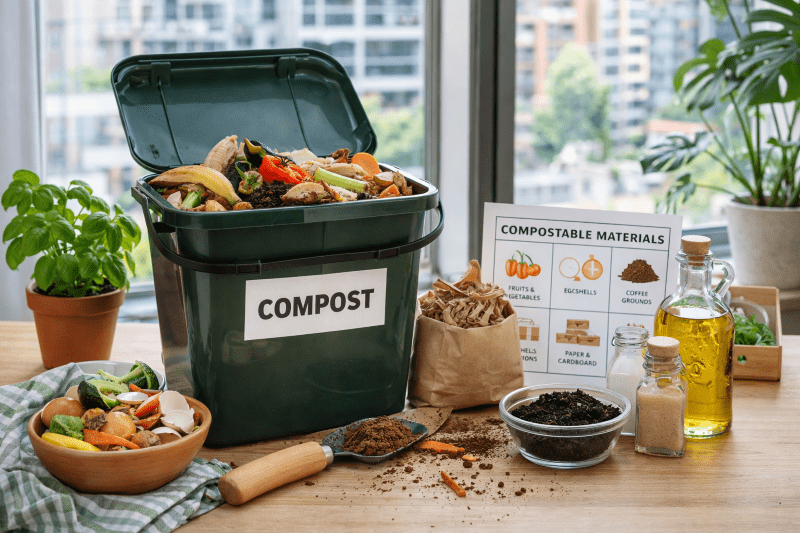
Have you ever thought that you can transform food scraps into natural fertilizer, even if you live in an apartment? Composting in your apartment is an efficient method to reduce food waste and contribute to environmental protection, even in small spaces. Plus, it’s simpler than it sounds – without unpleasant odors and without turning your balcony into a mini-farm.
In this article, you will learn everything you need to know about composting at home: methods, types of composters, how to avoid problems and what are the real benefits of urban composting.
Why compost at home?
Composting is not just a “green” activity, but an active form of sustainability. Here are a few reasons why it’s worth trying:
- ✅ You significantly reduce the volume of household waste
- ✅ You transform organic waste into nutrient-rich compost
- ✅ You get fertile soil for your apartment plants
- ✅ Set a positive example in your community
- ✅ Reduce your carbon footprint
What can you compost?
| YES (compostable materials) | NO (avoid this waste) |
|---|---|
| Vegetable and fruit peels | Meat, fish, dairy |
| Coffee grounds, tea bags | Oils, fats |
| Eggshells | Animal droppings |
| Leaves, dried flowers | Chemically treated products |
| Unwaxed cardboard, tissues | Plastic, metal, glass |
Types of composting suitable for the apartment
1. Classic composting in a closed container
- How it works: Special, aerated containers are used, into which compostable waste is placed.
- Advantages: Simple, cheap, available online.
- Disadvantages: Requires regular mixing and attention to moisture levels.
- Tips: Choose a container with a lid, air filters and a drainage system.
2. Vermicomposting (with earthworms)
- How it works: Red worms (Eisenia fetida) process organic waste and transform it into high-quality compost.
- Advantages: Nutrient-rich, odor-free compost.
- Disadvantages: Worms require a constant temperature (18–25°C); they can’t eat citrus fruits, onions, garlic.
- Where to find earthworms: online or in garden stores.
3. Bokashi composting (anaerobic fermentation)
- How it works: The scraps are placed in an airtight bucket with bokashi bran (which contains effective microorganisms).
- Advantages: Fast process, can also include meat, dairy.
- Disadvantages: It requires the purchase of bokashi bran constantly.
- Ideal for: People who want to compost without turning or mixing the material.
Where can you keep the compost in the apartment?
- Under the sink – ideal for vermicompost or bokashi.
- On the balcony (closed) – classic container or vermicompost, sheltered from direct sunlight.
- In the closet – if ventilated, it can be a discrete space.
- In interior hallways away from strong light.
Recommendation: Choose compact containers with an airtight lid to avoid leaks and odors.
What do you do with the obtained compost?
- Use it for plant pots (mixed with classic soil)
- Give it to friends who have gardens
- Donate it to local groups dedicated to urban agriculture
- You can check if there is one in your city community compost collection center
Common problems and how to avoid them
| Problem | Cause | Solution |
|---|---|---|
| Unpleasant smell | Too much wet material, lack of aeration | Add dry material (cardboard, paper) and mix |
| Flies/small insects | Exposed scraps, too much sugar | Cover the layers well and seal tightly |
| Compost too wet | Watery leftovers (melons, salads) | Add sawdust, shredded newspapers |
| Slow decomposition | Low temperature, lack of oxygen | Move the container to a warmer location and aerate it |
Composting in your apartment – accessible sustainability
Whether you choose the worm method, bokashi or classic composting, apartment composting is a concrete step toward a more responsible lifestyle. You don’t need a big garden, just a corner of your apartment, a little willpower and curiosity.
Small gestures matter. A single liter of compost from otherwise discarded waste means less litter, less gas emissions and more natural food for your plants.


Comments are closed.